Landmarks in Florence
A medieval trade and finance city crowned by the largest masonry dome ever built.
Florence's landmarks sit close together around the Piazza del Duomo and the Arno, legacy of a city that grew wealthy on medieval trade and finance and later became the centre of the Renaissance. The cathedral's marble panels in green, pink and white, capped by a dome that remains the largest masonry dome ever built, stand a few streets from the Palazzo Vecchio, once seat of the Republic's ruling council, and from the shop-lined arches of the Ponte Vecchio, the only Florentine bridge spared destruction in the Second World War. Away from that core, two mendicant orders raised rival basilicas: the Franciscans' Santa Croce and the Dominicans' Santa Maria Novella, its geometric marble façade begun in the Gothic period and finished under Renaissance direction.
Florence Cathedral
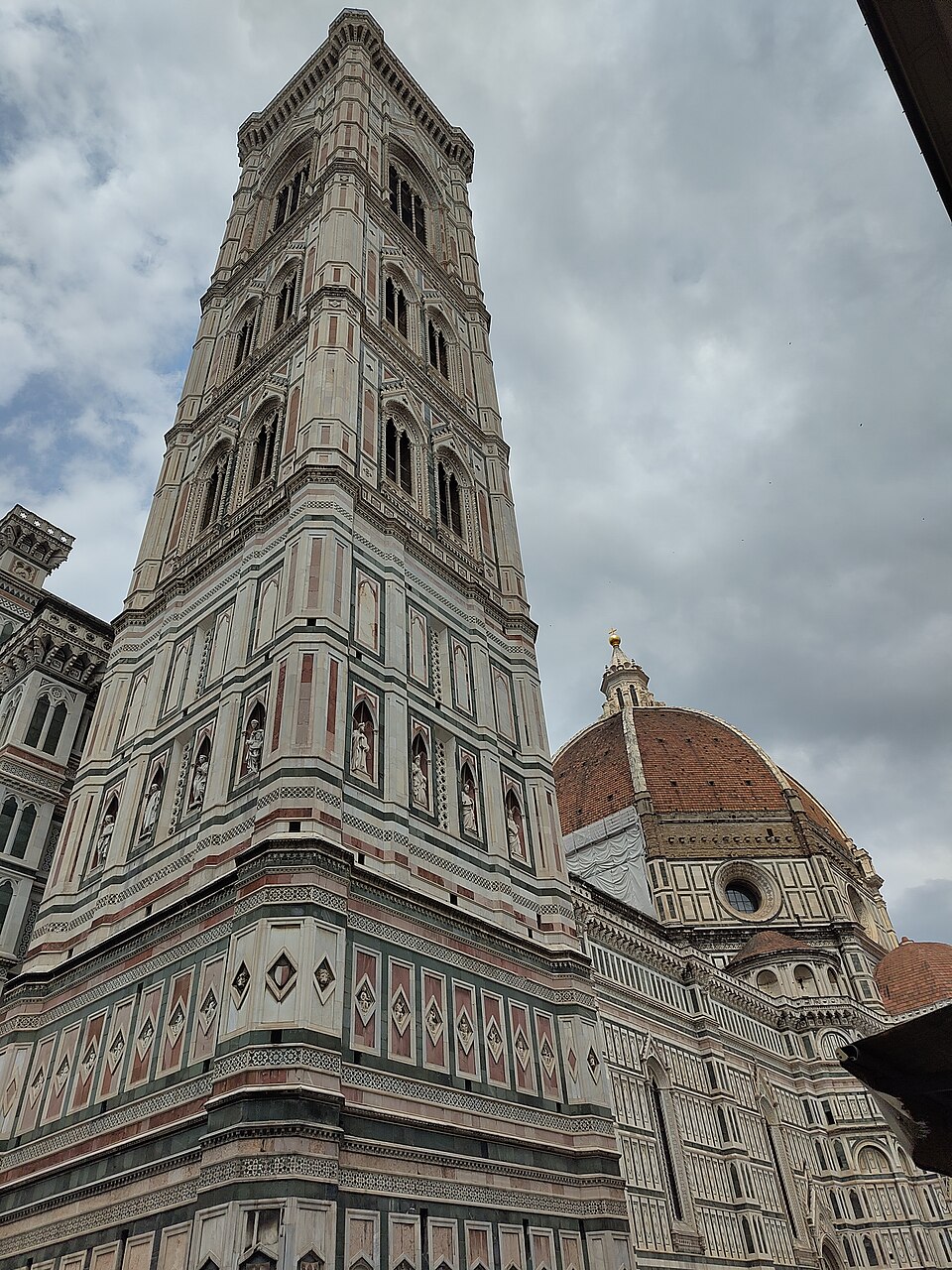
1296–1436 · Filippo Brunelleschi
The exterior is faced in alternating panels of green, pink and white marble, while the elaborate west front, in a 19th-century Gothic Revival style, looks visibly newer than the rest of the building it fronts. It stands alongside the Baptistery and Giotto's Campanile as one of the largest church complexes in the world.
The cathedral of the Catholic Archdiocese of Florence, begun in 1296 to a Gothic design by Arnolfo di Cambio and completed in 1436, when Filippo Brunelleschi's dome was finished. One of the world's largest churches, it forms a complex with the Baptistery and Giotto's Campanile, together part of a UNESCO World Heritage Site covering the historic centre. Its west façade, in a 19th-century Gothic Revival style by Emilio De Fabris, was added centuries after the rest of the building. It remains the seat of the Archdiocese of Florence.
- The dome remains the largest masonry dome ever constructed.
- The west façade was not added until the 19th century, in a Gothic Revival design very different from the medieval body it fronts.
Photo: Daniel Mietchen (CC0)
Palazzo Vecchio
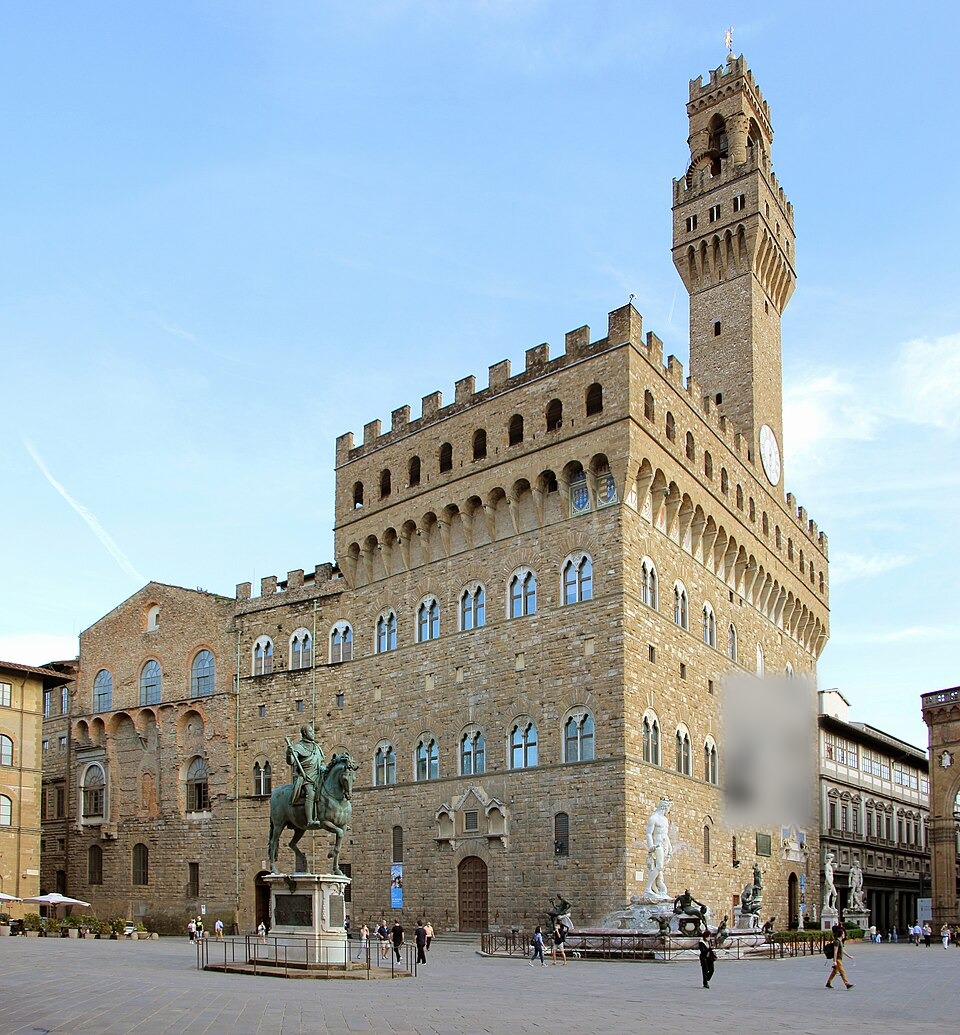
1314 · Arnolfo di Cambio
It overlooks the Piazza della Signoria, fronted by a copy of Michelangelo's David and the open-air gallery of statues in the adjoining Loggia dei Lanzi, and mixes Romanesque and Gothic architectural elements.
Built as the town hall of the Republic of Florence, this palace was originally called the Palazzo della Signoria after the Signoria, the city's ruling council, and later known also as the Palazzo del Popolo, Palazzo dei Priori and Palazzo Ducale as its use changed. It took its current name once the ruling Medici duke's residence moved across the Arno to the Palazzo Pitti, freeing this building for other uses. It overlooks the Piazza della Signoria and the Loggia dei Lanzi's gallery of statues.
- The building has carried at least four different names over the centuries — Palazzo della Signoria, del Popolo, dei Priori and Ducale — reflecting shifts in who governed from it.
Photo: Francesco Bini (CC BY-SA 4.0)
Ponte Vecchio
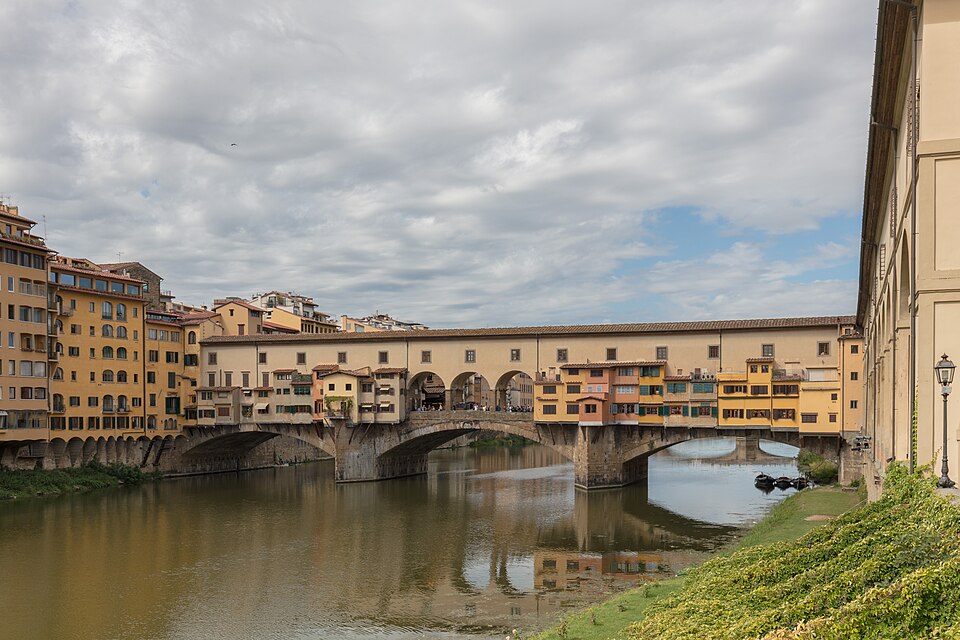
1345 · Neri di Fioravante
A stone segmental arch bridge whose deck is built up with shops on both sides — once occupied by butchers and tanners, now by jewellers, art dealers and souvenir sellers — and today closed to vehicles, carrying only foot traffic between the two riverbanks.
A medieval stone bridge built with closed-spandrel segmental arches, it took its name once the newer Ponte alla Carraia was built nearby, becoming the 'old bridge' by comparison. Shops have lined its deck since medieval times, first worked by butchers, tanners and farmers and now by jewellers, art dealers and souvenir sellers. The only Florentine bridge to survive the Second World War undamaged, it remains closed to vehicles and carries heavy pedestrian traffic between two of the city's main squares.
- A Roman crossing on this site once linked the road network to the Via Cassia Nova, commissioned by the emperor Hadrian in 123 AD.
Photo: Diego Delso (CC BY-SA 4.0)
Basilica of Santa Croce
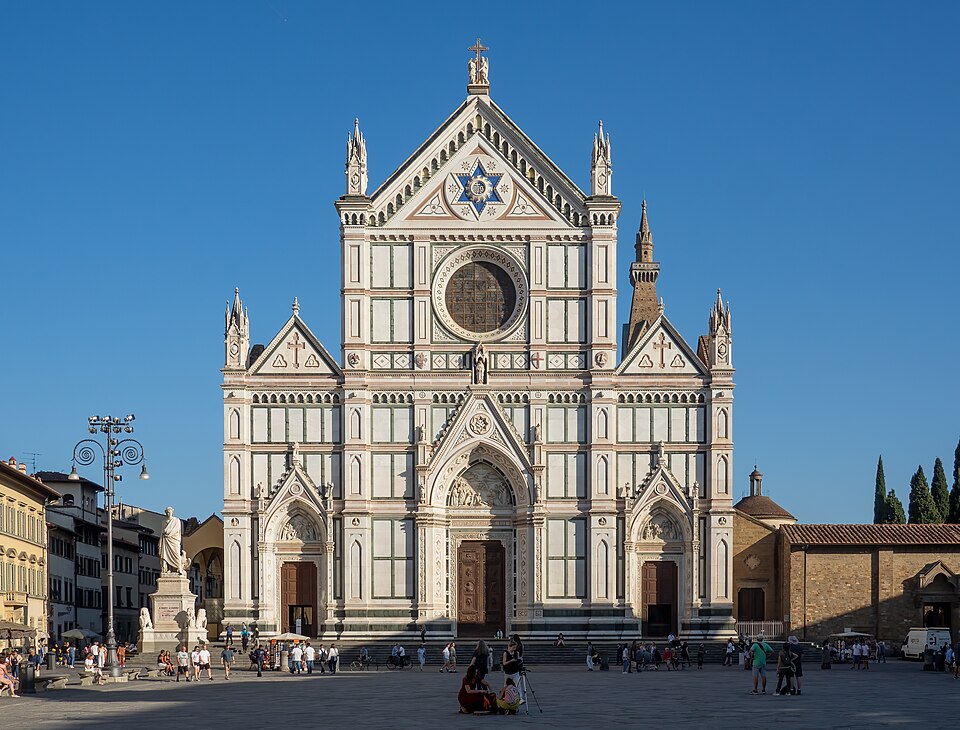
1294–1385 · Arnolfo di Cambio
Known as the Temple of the Italian Glories for the tombs of Michelangelo, Galileo, Machiavelli and other noted Italians inside, this Gothic-style basilica stands on the Piazza di Santa Croce, about 800 metres southeast of the cathedral.
The principal Franciscan church of the city, raised on what had been marshland beyond the old walls, about 800 metres southeast of the cathedral. It is best known as a burial place for notable Italians: the Renaissance figures Michelangelo and Machiavelli, the scientist Galileo, the poet Foscolo, the philosopher Gentile and the composer Rossini all lie inside, which is why the church is also called the Temple of the Italian Glories.
Photo: Rhododendrites (CC BY-SA 4.0)
Santa Maria Novella
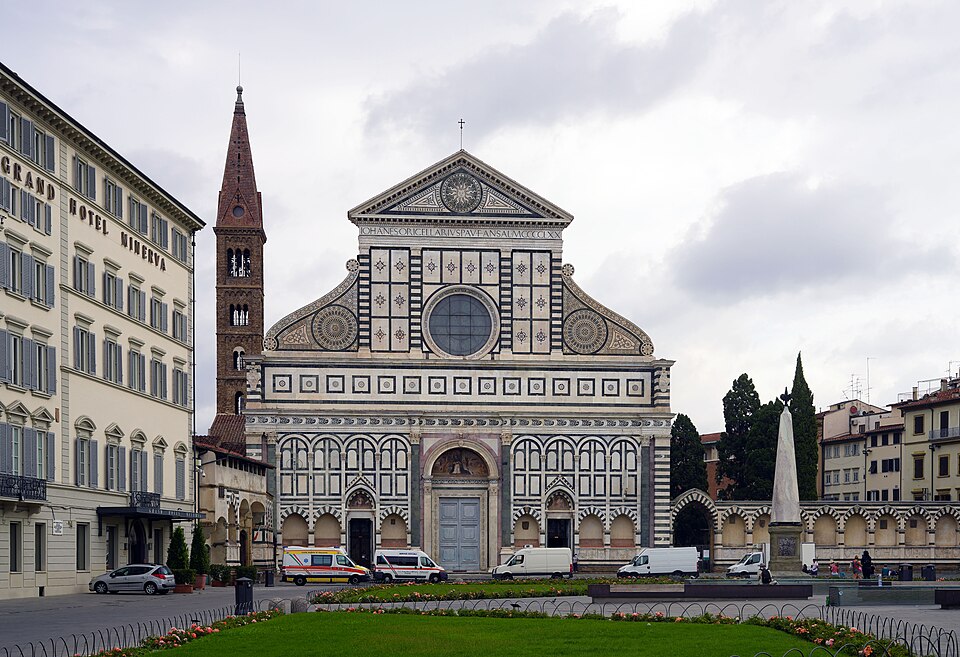
1290–1420 · Fra' Ristoro da Campi
The façade's geometric pattern of white and green marble includes an upper section added in 1470 by Leon Battista Alberti, visibly different in style from the older lower register. Inside are Giotto's Crucifix and Masaccio's Holy Trinity, the first monumental Renaissance painting built on linear perspective.
A Dominican church considered the most important Romano-Gothic building in Tuscany, construction on it began in 1290 and took nearly two centuries, ending with consecration in 1420; the upper part of the façade was added only in 1470, by Leon Battista Alberti. Wealthy Florentine families financed the building and its decoration in return for funerary chapels inside. It is a World Heritage Site and holds Giotto's Crucifix and Masaccio's Holy Trinity, among the most influential paintings of their respective periods.
- Giotto's Crucifix inside changed how Christ on the cross was depicted in art for the following two centuries.
Photo: Commonists (CC BY-SA 4.0)
David
Carved by Michelangelo between 1501 and 1504, the 5.17-metre marble giant was the first colossal marble statue of the High Renaissance. Unveiled in Piazza della Signoria in 1504, it moved to the Galleria dell'Accademia in 1873, with a replica installed there in 1910.
Florence Baptistery
An octagonal religious building dedicated to John the Baptist, standing between the cathedral and the Archbishop's Palace on Piazza del Duomo. Infants were once baptized there in large groups until a smaller font, commissioned around 1370, replaced the original, which was dismantled in 1577.
Palazzo Pitti
A vast Renaissance palace south of the Arno near the Ponte Vecchio, its core dating from 1458 as banker Luca Pitti's town residence. Bought by the Medici in 1549, it became the Grand Dukes of Tuscany's chief residence and later a power base for Napoleon.
Uffizi
An art museum beside Piazza della Signoria, among the most visited museums anywhere, with a collection focused on the Italian Renaissance. Its Medici holdings passed to the city under an 18th-century pact, opening to the public in 1769 and becoming a museum in 1865.
Giotto's Campanile
A free-standing bell tower beside Florence Cathedral on Piazza del Duomo, designed by Giotto and considered a showpiece of Florentine Gothic architecture. Square in plan with 14.45-metre sides, it rises 84.7 metres in five stages, decorated with rich sculpture and polychrome marble.
Piazza della Signoria
A W-shaped square in front of the Palazzo Vecchio, named after that building and long the political focus of the Florentine Republic. Gateway to the Uffizi Gallery, it anchors the Historic Centre that was designated a UNESCO World Heritage Site in 1982.
Fountain of Neptune
A monumental fountain near the Palazzo Vecchio in Piazza della Signoria, commissioned by Cosimo I de' Medici in 1559 to celebrate his gift of clean water. Designed by Baccio Bandinelli and executed by Bartolomeo Ammannati between 1560 and 1574, it was restored in 2019.
Boboli Gardens
A large park originally designed as the Pitti Palace garden for the Medici family in the mid-16th century, an early Italian garden that influenced aristocratic gardens across Europe. It contains statues of various styles and periods, large fountains and artificial grottoes.
Ospedale degli Innocenti
A historic foundling hospital designed by Filippo Brunelleschi, commissioned in 1419 by the Silk Guild of Florence and regarded as a notable early Renaissance building. Its nine-bay loggia faces Piazza SS. Annunziata, and since 1988 it has housed the UNICEF Innocenti Research Centre.
Basilica of San Lorenzo
One of the city's largest churches, consecrated in 393 AD when it stood outside the walls, and for three centuries its cathedral before Santa Reparata took over. It is the burial place of the Medici family, from Cosimo il Vecchio to Cosimo III.
Palazzo Medici Riccardi
A 15th-century Renaissance palace designed by Michelozzo di Bartolomeo for Cosimo de' Medici and built between 1444 and 1484, known for its rusticated stone masonry and ashlar work. Now the seat of the Metropolitan City of Florence's administration, it also houses a museum.
Palazzo Strozzi
A palace in the historic centre of Florence, between Via Strozzi, Piazza Strozzi and Via Tornabuoni.
Santo Spirito
A church in the Oltrarno quarter, facing the piazza of the same name, usually known simply as Santo Spirito. Its interior, 97 metres long, is one of the preeminent examples of Renaissance architecture.
San Miniato al Monte
A basilica standing atop one of the city's highest points, described as one of the finest Romanesque structures in Tuscany and one of Italy's most scenic churches. An adjoining Olivetan monastery sits beside it, visible to the right when climbing the stairs.
Orsanmichele
A communal building and church whose name comes from a Tuscan phrase meaning 'orchard of Saint Michael', originally a grain market, granary and oratory. Its façades carry sculptures of Florence's guild patron saints, including early works by Ghiberti, Donatello and Nanni di Banco.
Loggia dei Lanzi
A building on the south corner of Piazza della Signoria adjoining the Uffizi Gallery, with three tall wide arches resting on cluster columns with Corinthian capitals. The arches so appealed to Florentines that Michelangelo proposed continuing them all around the piazza.
Piazza della Repubblica
A city square built over the site of the Roman forum and later the Jewish ghetto, cleared during the Risanamento works when Florence briefly served as Italy's capital. Its Giubbe Rosse cafe has long been a meeting place for artists and writers, notably the Futurists.
Bargello
A former public building, police headquarters and prison, mostly built in the 13th century and now home to the Museo Nazionale del Bargello since 1865. Its Cappella della Maddalena preserves damaged frescoes by Giotto, including a full-length portrait of Dante.
Medici Chapels
Two chapels built between the 16th and 17th centuries as an extension to the Basilica of San Lorenzo, celebrating the Medici family, patrons of the church and Grand Dukes of Tuscany. They comprise the Sagrestia Nuova, designed by Michelangelo, and the larger Cappella dei Principi.
Vasari Corridor
A 16th-century elevated passageway connecting the Palazzo Vecchio with the Palazzo Pitti, designed by Giorgio Vasari so Duke Cosimo I de' Medici could move between them undisturbed. It crosses the Ponte Vecchio and winds through the Oltrarno district on its way to the Boboli Gardens.
Perseus with the Head of Medusa
A bronze sculpture by Benvenuto Cellini, made between 1545 and 1554, standing in the Loggia dei Lanzi on the Piazza della Signoria. Commissioned by Duke Cosimo I de' Medici, it was unveiled on 27 April 1554 alongside Michelangelo's David and other sculptures in the piazza.
Pazzi Chapel
A chapel in the first cloister on the southern flank of the Basilica di Santa Croce, commonly credited to Filippo Brunelleschi. It is considered one of the masterpieces of Renaissance architecture.
Great Synagogue of Florence
An Orthodox Jewish congregation and synagogue on Via Luigi Carlo Farini, designed in Italian and Moorish Revival styles and completed in 1882. One of the largest synagogues in south-central Europe, it now also houses the Jewish Museum of Florence.
Fort Belvedere
A fortification also known as the Forte di Belvedere or Fortezza di Santa Maria in San Giorgio del Belvedere.
Palazzo Rucellai
A 15th-century townhouse on Via della Vigna Nuova, designed for Giovanni di Paolo Rucellai by Leon Battista Alberti between 1446 and 1451. Its grid-like facade, using pilasters and entablatures in careful proportion, was one of the first to express Renaissance architectural ideas.
History
Florence grew wealthy on medieval trade and finance, and that wealth built its skyline. The city's Republican government raised the Palazzo Vecchio as its seat from 1314, while the Franciscans and Dominicans began their own basilicas, Santa Croce and Santa Maria Novella, in the same Gothic decades. Work on the cathedral started in 1296 to Arnolfo di Cambio's design and continued for well over a century; Filippo Brunelleschi's dome, completed in 1436, marked the city's shift from Gothic building toward the Renaissance it is credited with starting. The Medici family's long dominance funded further building and patronage, and a Gothic Revival façade was added to the cathedral only in the 19th century, under Emilio De Fabris. Florence briefly served as capital of the Kingdom of Italy from 1865 to 1871.