Landmarks in Chiang Mai
Red-brick ramparts and a moat still frame temples founded within the city's first century.
Chiang Mai's oldest monuments sit inside a square kilometre and a half of walled, moated ground laid out in 1296, when the settlement became the new capital of Lan Na. Wat Chiang Man rose within a year of that founding; Wat Phra Singh followed by the mid-fourteenth century; and Wat Chedi Luang's own founding is dated anywhere from the late thirteenth to the mid-fifteenth century, depending on which record is consulted. All three are wats, walled Buddhist temple compounds, rather than palaces, forts or civic buildings, which is why the old core reads as a cluster of religious enclosures behind brick ramparts rather than a seat of visible secular power. Nothing here is dated later than the fifteenth century.
Wat Phra Singh
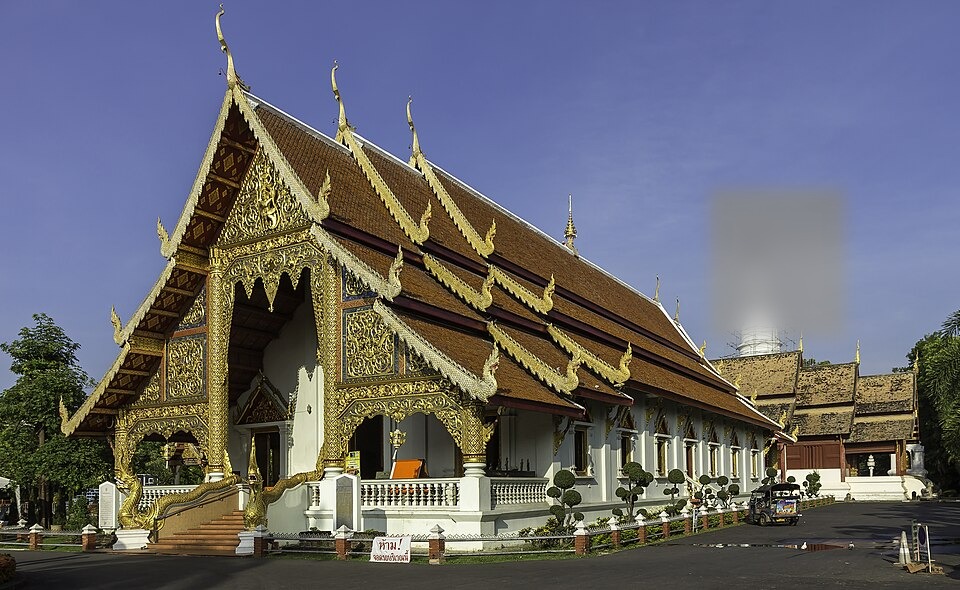
1345
Identified less by its outline than by what it holds: a seated Buddha figure known as Phra Buddha Sihing, kept enshrined inside the temple rather than displayed on its exterior.
Wat Phra Singh is a Buddhist temple complex in Chiang Mai founded around 1345. Its full name is recorded as Wat Phra Singh Woramahaviharn, rendered in the Royal Thai General System as Wat Phra Sing Wora Maha Wihan. The temple is the enshrinement site of the Phra Buddha Sihing, a seated Buddha image kept inside it rather than displayed outdoors, which gives the complex a devotional significance separate from its layout or architecture. It is a registered Thai historic site and remains in active use.
Photo: Stefan Fussan (CC BY-SA 3.0)
Wat Chedi Luang
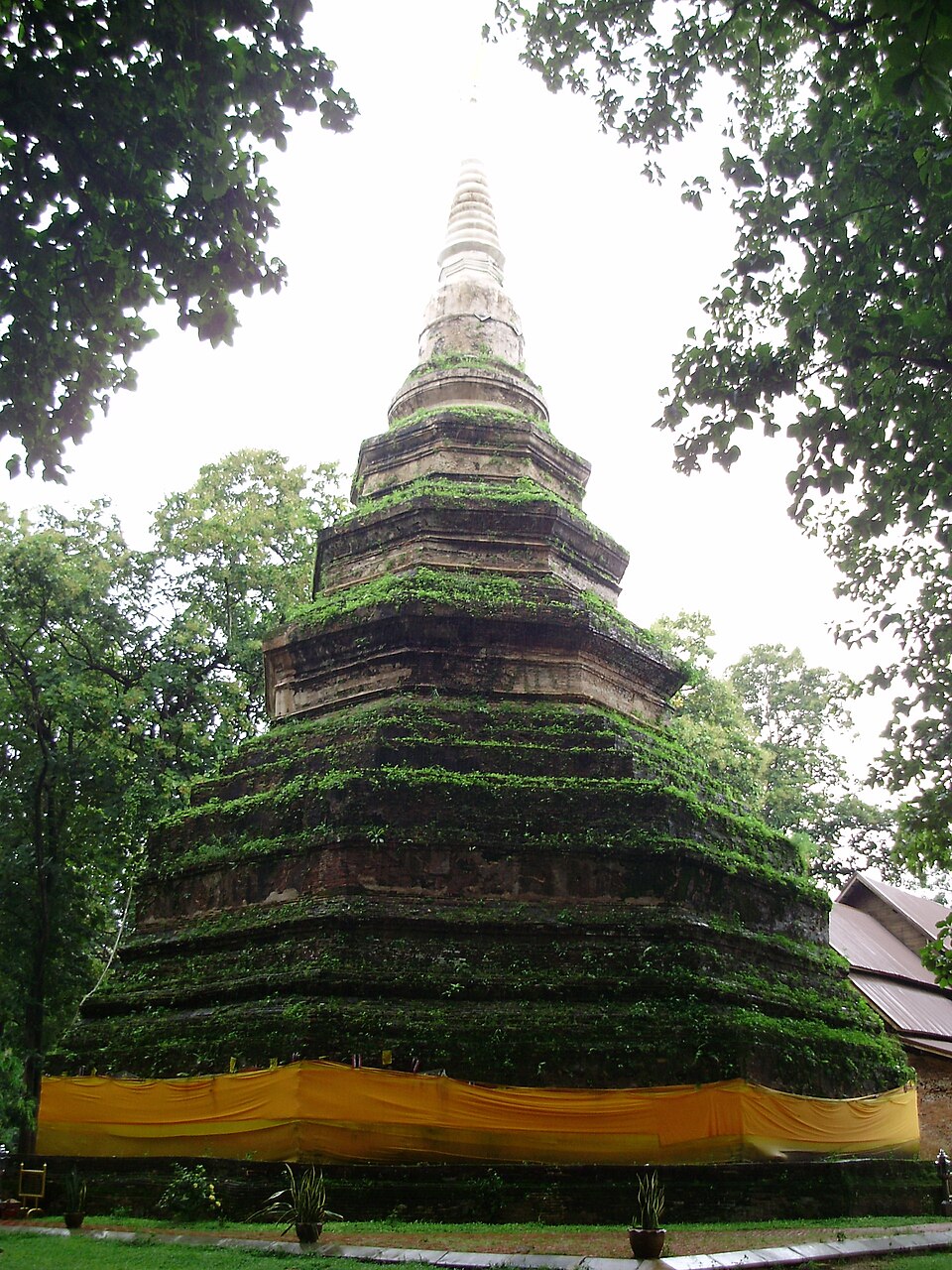
1441
No description of its current structure, materials or layout is recorded; what distinguishes it in the sourced record is that its grounds combine three formerly separate temples into a single compound.
Wat Chedi Luang is a Buddhist temple in the historic centre of Chiang Mai, built in 1441. Its name is popularly translated as the temple of the grand stupa. The grounds seen today were formed by merging three separate temples that once stood on the same site, Wat Chedi Luang, Wat Ho Tham and Wat Sukmin, into a single compound. It is a registered Thai historic site and remains in active use as a place of worship.
- Its name is popularly translated as "the temple of the grand stupa."
- Its grounds were formed by merging three separate temples, Wat Chedi Luang, Wat Ho Tham and Wat Sukmin, into one compound.
Photo: Sarawut VRW (CC BY-SA 3.0)
Wat Chiang Man
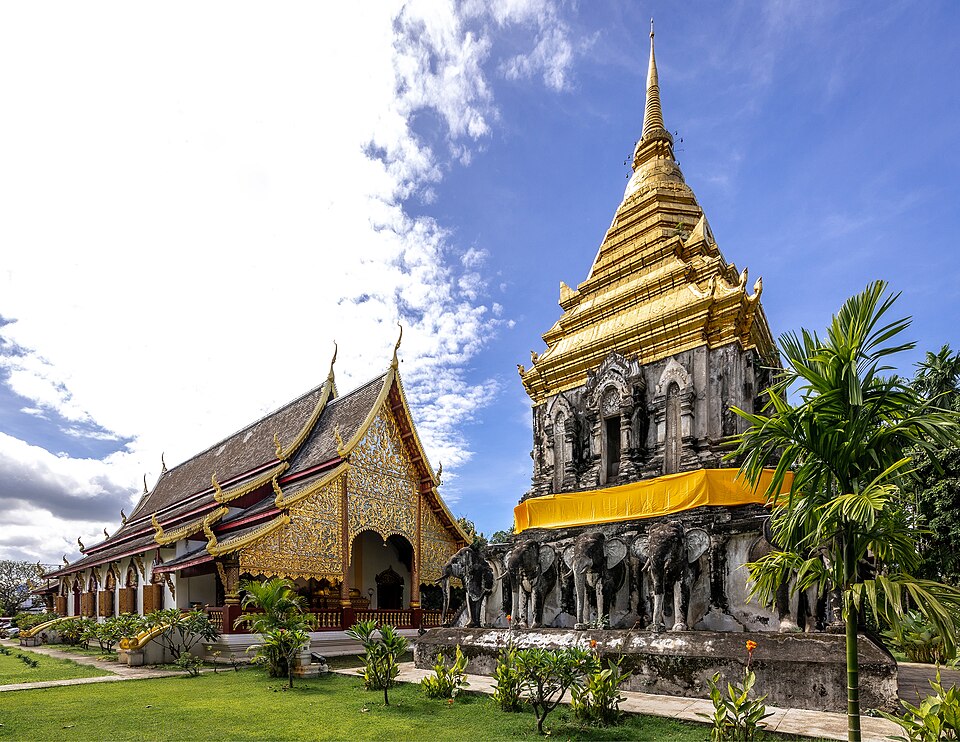
1297
Located inside the old city's walled, moated square, among the same brick ramparts and water that still define that historic core, rather than standing apart from it.
Wat Chiang Man is a Buddhist temple inside the old walled and moated quarter of Chiang Mai, founded in 1297, within a year of the city itself being laid out as the new capital of Lan Na. Its position inside the original defensive square, bounded by brick ramparts and a moat, ties it directly to the city's founding rather than to any later expansion. It is a registered Thai historic site and continues to function as an active temple within that historic core.
Photo: This Photo was taken by Supanut Arunoprayote. Feel free to use any of my images, but please mention me as the author and may send me a message. (สามารถใช้ภาพได้อิสระ แต่กรุณาใส่เครดิตผู้ถ่ายและอาจส่งข้อความบอกกล่าวด้วย) Please do not upload an updated image here without consultation with the Author. The author would like to make corrections only at his own source. This ensures that the changes are preserved. Please if you think that any changes should be required, please inform the author. Otherwise you can upload a new image with a new name. Please use one of the templates derivative or extract. (CC BY 4.0)
Wat Phra That Doi Suthep
A Theravada Buddhist temple 15 kilometres from the city, perched at 1,073 metres on the mountain that lends it its common name. It is a sacred site for many Thai people and offers views over downtown Chiang Mai below.
Three Kings Monument
A bronze monument to Phaya Mangrai, Pho Khun Ramkhamhaeng and Phaya Ngammueang, the three founding kings of the Lanna Kingdom. Designed by national artist Kaimook Chuto, it was completed in 1983 and officially opened the following year.
Wat Chet Yot
Also called the 'seven-spired temple,' officially known as Wat Photharam Maha Wihan. It is a Buddhist pilgrimage site for people born in the year of the Snake.
Wat Suan Dok
A Royal Temple of the Third Class whose name means 'flower garden temple,' on Suthep Road about a kilometre west of the old moat. Its grounds also house the Chiang Mai campus of Mahachulalongkornrajavidyalaya University.
Wat Phan Tao
A Buddhist temple on Prapokklao Road in the centre of Chiang Mai's old city.
Wat Umong
A Buddhist temple in Chiang Mai said to be roughly 700 years old.
Wat Sri Suphan
A Buddhist temple on Wualai Road in the southern part of the old city, known as the 'Silver Temple.' Its ordination hall was built using silver, aluminium and nickel.
Wiang Kum Kam
A historic settlement and archaeological site along the Ping River, built by King Mangrai the Great as his capital before he moved it to Chiang Mai. Flooded and abandoned more than 700 years ago, the site flooded again three times in 2005.
Bhubing Palace
A royal residence located in Doi Buak Ha, in the Mueang district of Chiang Mai province.
Wat Phra That Doi Kham
A Buddhist temple atop Doi Kham hill, about 200 metres above sea level, whose name means 'Temple of the Golden Mountain's Relic.' It houses a sacred Buddha hair relic, a 1,300-year-old chedi and a 17-metre seated Buddha image.
Wat Pha Lat
A Buddhist temple on the slopes of Doi Suthep, its name meaning 'the monastery at the sloping rock.' Founded by King Kuena of Lanna in the 14th century, it served as a resting place for pilgrims climbing to Wat Phra That Doi Suthep.
Chang Phueak Monument
A monument of two elephants, also called the White Elephant Monument, standing near Chang Phueak Gate on the old city's north wall. It symbolizes loyalty and bravery from the Lanna period and is considered a sacred, highly respected local landmark.
Ban Ho Mosque
Known as Ban Ho Mosque, the Hedaytul Islam Mosque stands near the Chiang Mai Night Bazaar. Founded by Chinese migrants, it is one of the biggest of the city's seven mosques.
Suan Buak Hat Park
A 1.92-hectare public park in the southwest corner of the old city, open daily from 5 a.m. to 9 p.m. It hosts festivals such as the Flower Festival, and in 2022 a statue of musician Jaran Manophet was erected there.
Wat Ku Tao
Built around 1390, this Buddhist temple's name means 'Temple of the Gourd Pagoda.' Its distinctive Yunnanese-style chedi is arranged as five diminishing spheres representing the five historical and future Buddhas, and it now caters to the city's Shan community.
Wat Buppharam
Founded in 1497 by King Kaew, the temple is where Kawila began a ritual circuit to reclaim Chiang Mai after two centuries of Burmese rule. Its Burmese-style chedi was rebuilt in 1958, and its ordination hall, of teak and glass inlay mosaic, dates to 1819.
Sacred Heart Cathedral
A Catholic church also known as Chiang Mai Cathedral. It follows the Roman, or Latin, rite.
First Church
A Presbyterian church on the east bank of the Ping River in the city centre, completed in 1891. It was the first church built in Northern Siam.
History
Chiang Mai was founded in 1296 as the new capital of the kingdom of Lan Na, replacing Chiang Rai, on a bend of the Ping River within reach of regional trade routes. The founders laid the new capital out as a walled, moated square roughly a mile and a half on each side, and construction of its major temples began almost at once: Wat Chiang Man within the founding year itself, Wat Phra Singh by the mid-fourteenth century, and Wat Chedi Luang at some point across the following century and a half, though exactly when is disputed between sources. The brick ramparts that still trace that original square, now reduced mostly to corner fragments and a surrounding moat, mark the boundary of the city as it existed for its first centuries, before later growth spread population and building far beyond it.