Landmarks in Bern
Grey sandstone arcades and covered passages fill a medieval old town looped by the Aare.
Bern's landmarks cluster inside the loop the Aare carves around the old town, a UNESCO-listed core of sandstone arcades and covered passages laid out mostly after the 15th century. The Zytglogge, a guard tower turned clock tower, marks one of the old fortifications' gates and remains the oldest standing monument in the city. East of it, Bern Minster's Gothic tower, raised over more than four centuries, is the tallest of any cathedral in the country. Nydegg Church sits on the old town's eastern edge, in the district that gives it its name. Outside this medieval nucleus, the Federal Palace occupies the southwest edge of the old city: a Renaissance Revival and Beaux-Arts complex built in three phases between 1852 and 1902 to house the Swiss government and parliament.
Zytglogge
1218
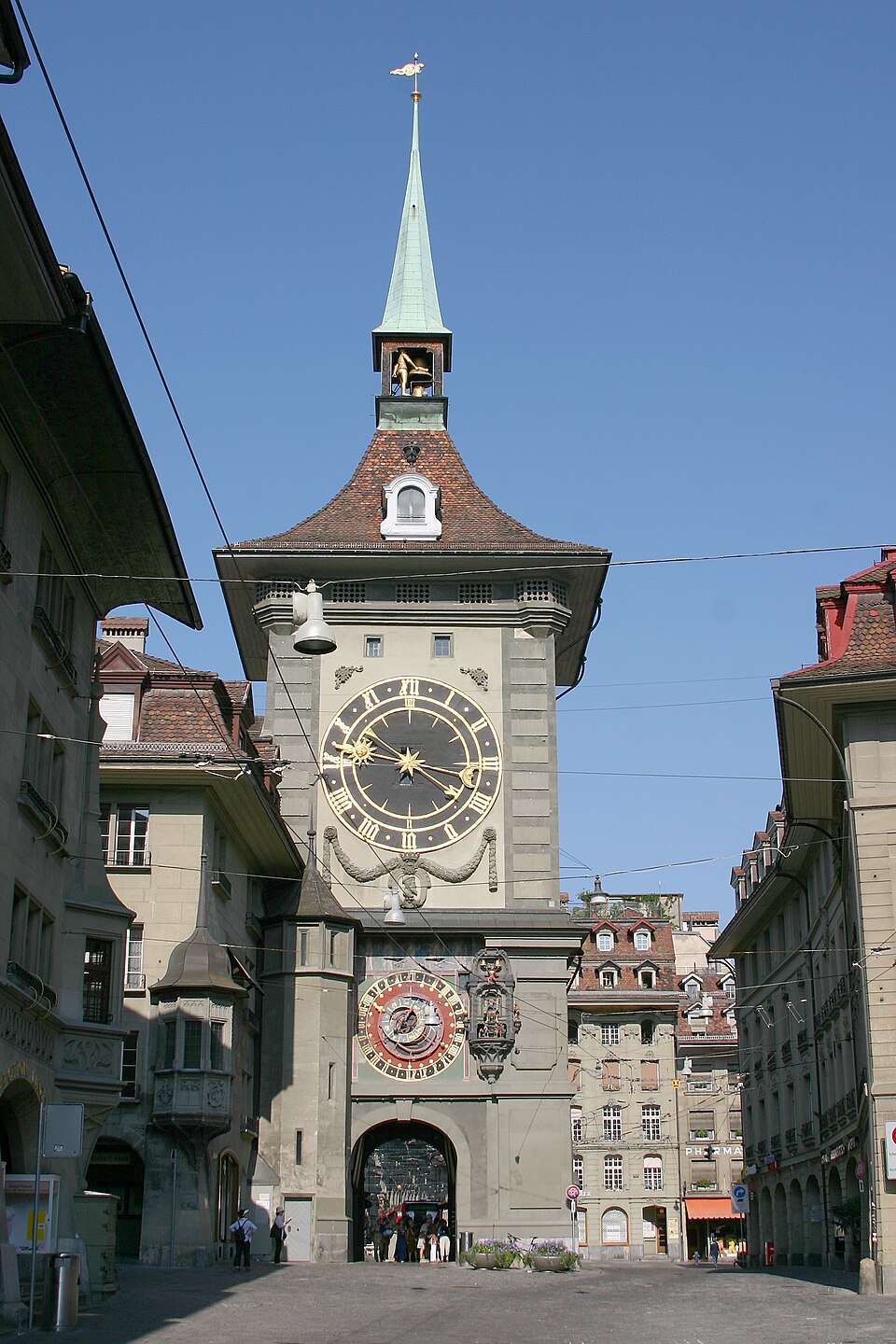
A squat, ochre-walled tower rising to a steep pyramidal roof; its face carries a gilded astronomical clock ringed with zodiac signs, and mechanical figures perform on a clockwork above it each hour.
The Zytglogge began in the early thirteenth century as a guard tower marking one of the gates in the city's fortifications, and over eight centuries it has also served as a prison, a clock tower and a civic memorial. Its fifteenth-century astronomical clock and mechanical figures, added long after the tower's construction, made it a fixture of daily life in the old town. Despite repeated redecoration and renovation, it remains Bern's oldest standing monument and part of the old city's UNESCO World Heritage Site.
Photo: Mike Lehmann, Mike Switzerland 13:37, 2 July 2006 (UTC) (CC BY-SA 3.0)
Federal Palace
1902 · Hans Wilhelm Auer
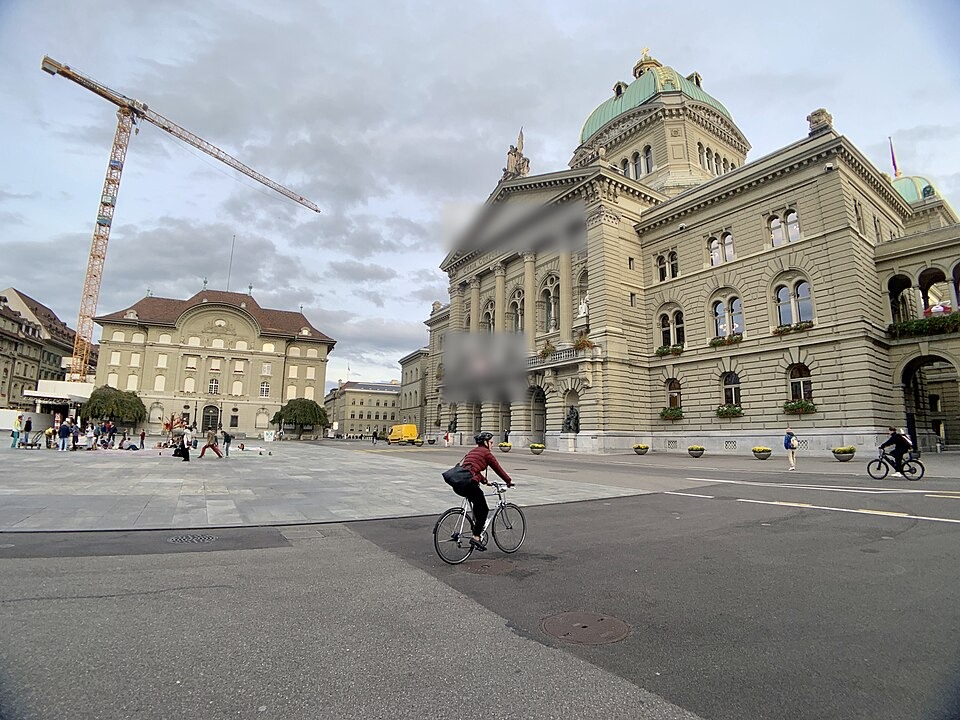
A long, low sandstone façade in Renaissance Revival dress, over three hundred metres end to end, made up of three visibly distinct wings built decades apart yet aligned into a single symmetrical composition.
The Federal Palace grew in three stages: a west wing built from 1852 to 1857 under Jakob Friedrich Studer to house the federal government, administration and parliament together; an east wing added from 1884 to 1892 under Hans Wilhelm Auer to relieve overcrowding; and a central parliament building, also by Auer, completed in 1902 to link the two. It remains the seat of the Federal Assembly and the Federal Council, and underwent its first comprehensive renovation early in the twenty-first century.
- The complex is a listed, symmetrical building just over three hundred metres long.
- More than thirty years separate the start of the east wing from the completion of the central parliament building.
Photo: Ank Kumar (CC BY-SA 4.0)
Bern Minster
1421–1893
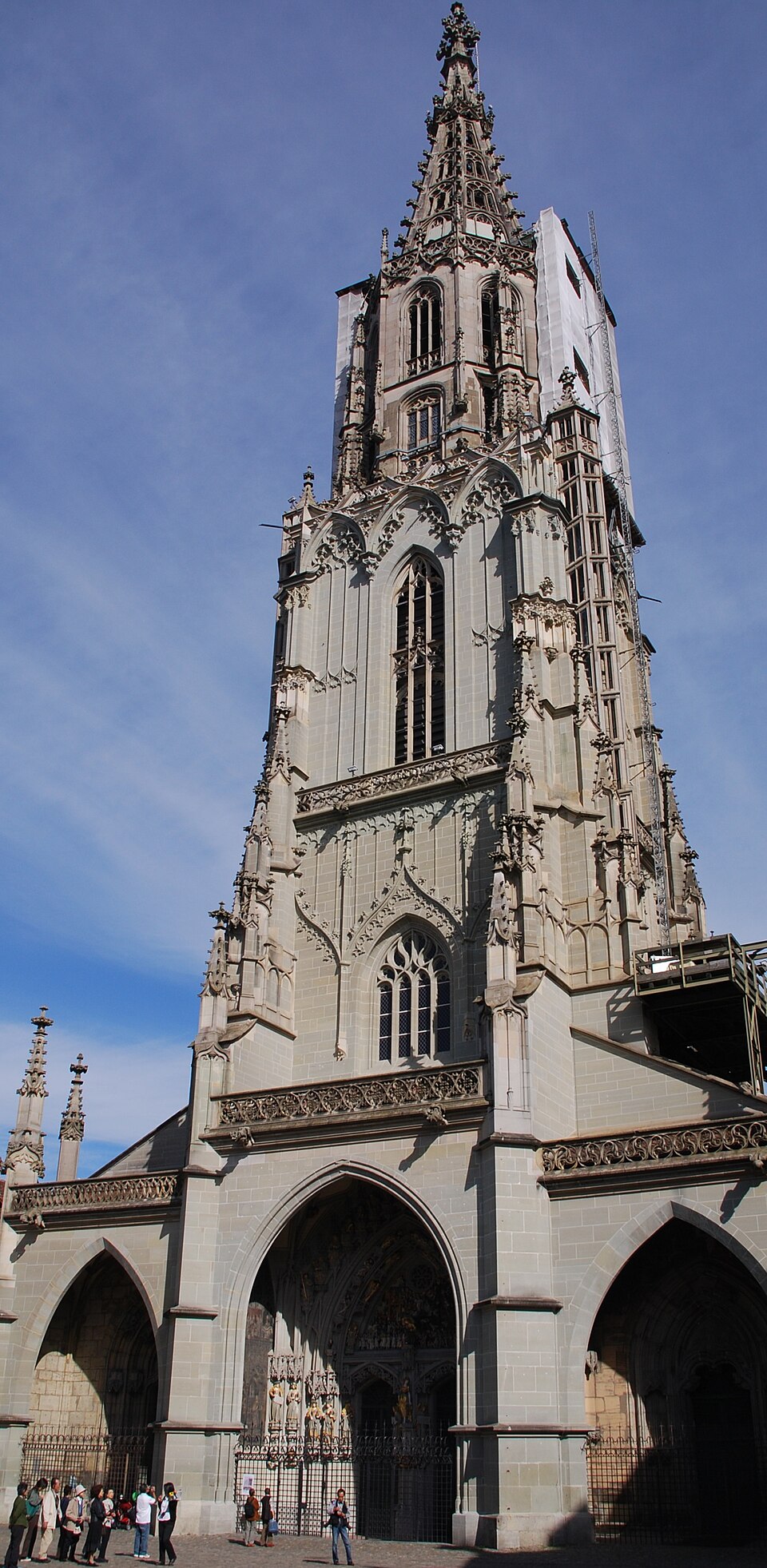
A single tall Gothic tower dominates the skyline, its spire reaching 100.6 metres, the tallest cathedral tower in the country; the upper stages were only added centuries after the nave below.
Bern Minster is a Reformed Protestant cathedral, classed as a minster, in the old city. Built in the Gothic style, it took over four centuries to complete: construction started in 1421, and the tower, standing 100.6 metres, was not finished until 1893. That height makes it the tallest cathedral tower in the country. The building is registered as a class A Swiss cultural property of national significance.
Photo: Wladyslaw Sojka (CC BY-SA 3.0)
Nydegg Church
1346
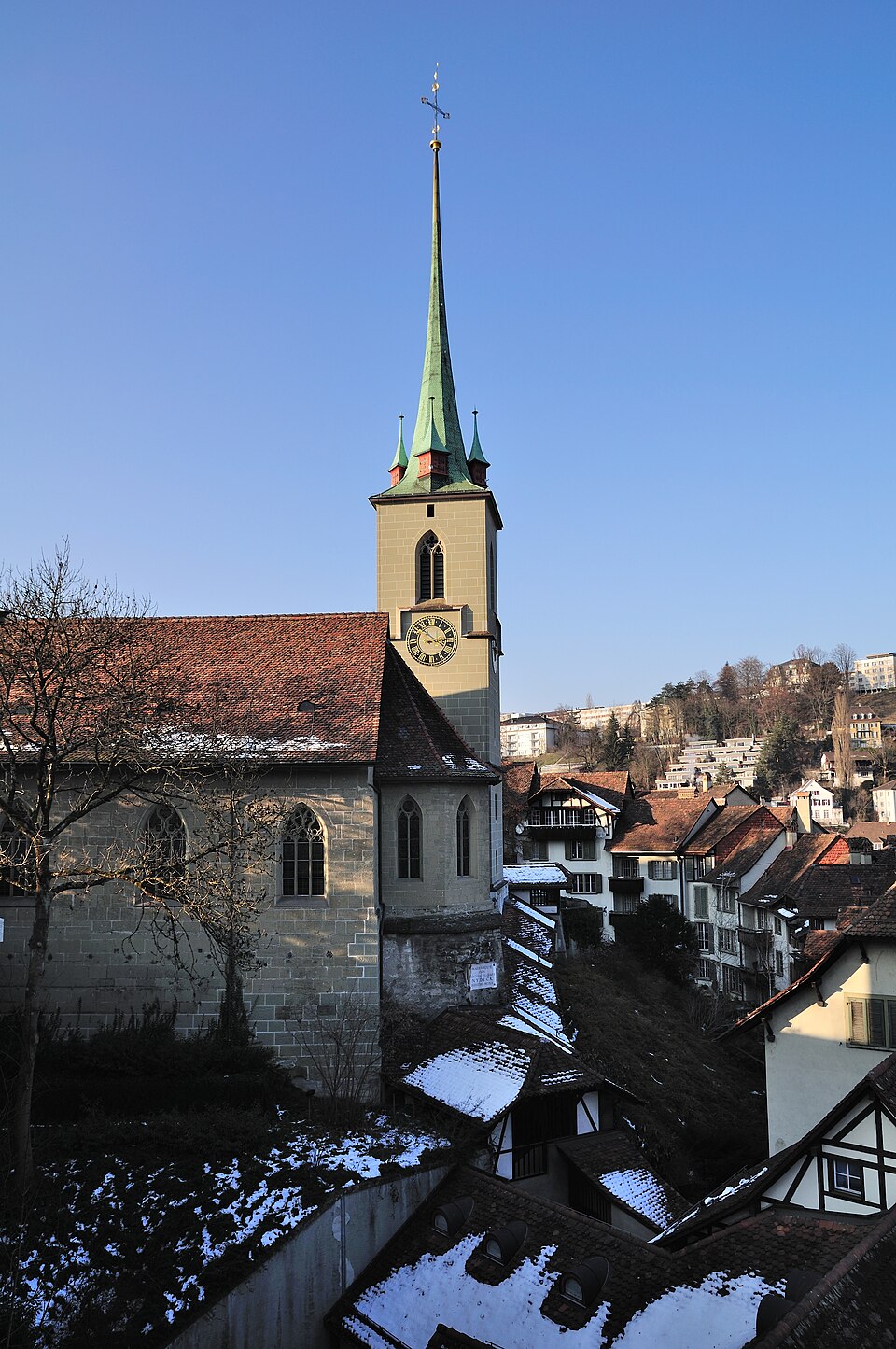
A modest Gothic-style church set at the eastern edge of the old town, in the low-lying district that gives it its name, away from the more monumental buildings toward the town's centre.
Nydegg Church, built in 1346 in the Gothic style, stands on the eastern edge of Bern's old city, in the Nydegg district after which it is named — a Bernese German term meaning roughly 'lower corner'. It functions as an Evangelical Reformed parish church and is listed as a class B Swiss cultural property of regional significance, a rank below the class A heritage sites elsewhere in the old town.
Photo: Wladyslaw Sojka at German Wikipedia (CC BY-SA 3.0)
Zentrum Paul Klee
A museum devoted to Paul Klee, designed by Renzo Piano and completed in 2005 on the Schöngrün site east of the city. It displays about 40 percent of Klee's pictorial output, built around a 1997 donation of nearly 690 works from his daughter-in-law.
Kindlifresserbrunnen
A painted stone fountain on Kornhausplatz, one of the Old City of Bern's fountains dating from the 16th century. Its Swiss German name, Kindlifresserbrunnen, translates as 'Child-Eater Fountain'.
Town Hall
The building housing the Grand Council and Executive Council of the canton of Bern, as well as the city's Grand Council, part of the UNESCO-listed Old City. The cantonal Grand Council meets there five times a year, for about two weeks each session.
Bundesplatz
The Government Plaza in front of the Bundeshaus, Switzerland's parliament building, within the medieval Old City built during the 1255-1260 expansion. It forms part of the UNESCO World Heritage Site covering the Old City, though the square itself was laid out much later.
Mosesbrunnen
A fountain on Münsterplatz in the Old City of Bern. It is a Swiss Cultural Property of National Significance and forms part of the UNESCO World Heritage Site covering the Old City.
Church of the Holy Ghost
A Swiss Reformed church at Spitalgasse 44 in the Old City of Bern, designated a Swiss heritage site of national significance. It is one of the largest Swiss Reformed churches in the country.
Hotel Bellevue Palace
A five-star luxury hotel in the Old City, owned by the Swiss Confederation and used as the state's guesthouse for visiting heads of state and government. It also hosts dozens of members of parliament during the weeks the Federal Assembly is in session.
Bärenplatz
A plaza in the medieval Old City, part of the Innere Neustadt built during the second expansion of 1255 to 1260. It sits north of Bundesplatz, west of the Käfigturm and south of Waisenhausplatz, within the UNESCO World Heritage Site covering the Old City.
Stadion Wankdorf
A football stadium and home ground of BSC Young Boys, the second-largest all-seater stadium in Switzerland. It hosted matches at UEFA Euro 2008 and UEFA Women's Euro 2025.
St Ursula's Church
An Anglican Episcopal church, one of ten Anglican chaplaincies in Switzerland with a resident chaplain. Together these chaplaincies form the Archdeaconry of Switzerland.
Tierpark Dählhölzli
A public zoo on the bank of the river Aare near the historic city center, opened in 1937 and owned by the city of Bern. It exhibits roughly 3,000 animals across 15 hectares and also cares for the bears kept at the Bärengraben.
Marzili Funicular
A very short funicular whose 105 metres of track link the Marzili neighbourhood to the Bundeshaus, seat of the Swiss federal government and parliament. It runs up into the Old City, the capital's medieval center.
Gurten Funicular
A funicular railway in Bern's southern suburbs, linking Wabern, in the municipality of Köniz, with the 858-metre summit of the Gurten mountain overlooking the city. It connects to the Bern S-Bahn and tramway route 9, and is owned and operated by Gurtenbahn Bern AG.
Historical Museum
The second-largest historical museum in Switzerland, designed by architect André Lambert and built in 1894 in the style of 15th- and 16th-century castles. Originally conceived as the Swiss National Museum before that role went to Zurich, it gained an extension completed in 2009.
Museum of Fine Arts
The fine arts museum of Switzerland's de facto capital, established in 1879.
Church of St. Peter and Paul
A Christian Catholic church in Bern, designated a Cultural Property of National Significance.
Bern Theatre
An opera house and theatre known locally as Stadttheater Bern. It works across four areas: the Bern Symphony Orchestra, Musiktheater opera, Schauspiel theatre and Tanz dance.
Westside Shopping and Leisure Centre
A multi-use facility on the outskirts of Bern, with shops, restaurants, a swimming pool, conference spaces, residences, a hotel, fitness centres and a cinema. It was designed by architect Daniel Libeskind and completed in October 2008.
PostFinance Arena
An indoor arena originally known as Eisstadion Allmend and Bern Arena, opened in October 1967 and now accommodating 17,031 people. It is used primarily for ice hockey and is the home arena of SC Bern.
Anna-Seiler-Brunnen
A fountain on Marktgasse in the Old City of Bern. It is a Swiss Cultural Property of National Significance and forms part of the UNESCO World Heritage Site covering the Old City.
History
Fortified settlements had stood on the site since antiquity, but the city proper was founded around 1191 by Berthold V, Duke of Zähringen, on the peninsula the Aare loops around. Bern became a free imperial city in 1218 and joined the Swiss Confederacy in 1353, then expanded for centuries as a sovereign city-state controlling territory well beyond its walls. From the 15th century the town was rebuilt piece by piece in the sandstone that still faces its arcaded streets, giving the old town the uniform look it has kept since. Bern was made the federal city in 1848, and the government complex that followed, the Federal Palace, was raised in stages through the second half of the nineteenth century to house the new state.