Landmarks in Beirut
Roman ruins, an Ottoman palace and a Neoclassical cathedral share a war-rebuilt downtown.
Beirut's landmarks cluster tightly in and around the downtown core, on and beside the hill that once carried the city's Ottoman administration. Excavated Roman bath remains sit sunk below current street level, hemmed in on all sides by government offices built two millennia later. On Serail Hill nearby, a mid-nineteenth-century Ottoman palace shares high ground with another Ottoman administrative block and a clock tower. A short walk away, a Neoclassical cathedral raised in the 1880s and 1890s replaced an eighteenth-century church, its forecourt covering Hellenistic and Roman street remains. Civil war, the 2006 war and the 2020 port explosion have each damaged this small cluster of survivors, so most of what stands today has been restored at least once rather than left untouched.
Roman Baths
200 AD
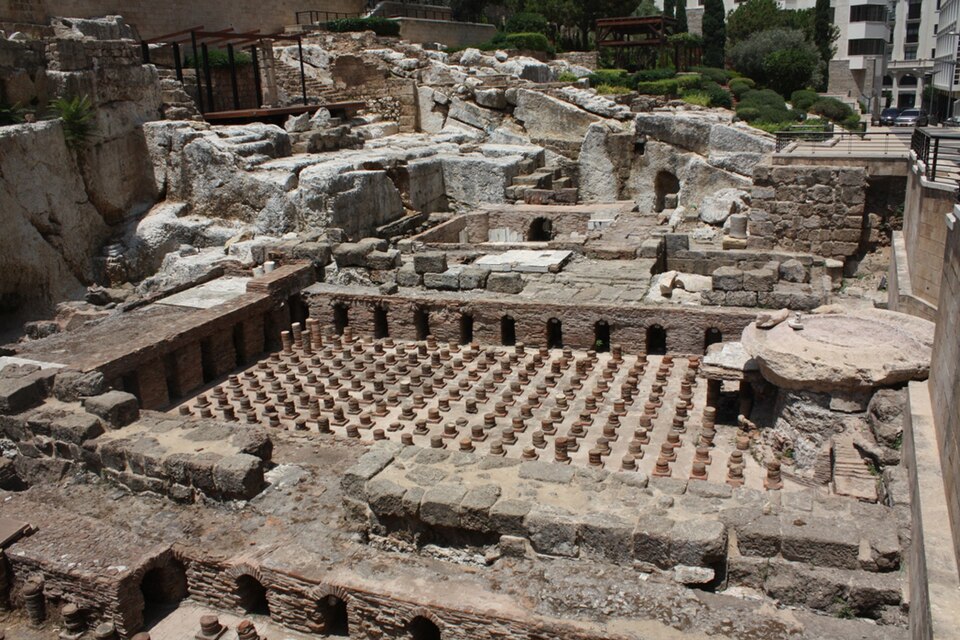
A cluster of excavated Roman masonry sitting below current street level, walled in by modern government buildings on every side.
The Roman Baths of Berytus lie exposed in the middle of downtown Beirut, the surviving core of a public bathing complex from when the city was a Roman colony. Excavation uncovered the remains and stabilised them for display, leaving walls and foundations visible below current street level. Modern government buildings now stand close around the site on every side. Beirut has been inhabited for more than five thousand years, and this bathing complex is among the few ancient structures in the city to have survived at all.
Photo: A.K.Khalifeh (CC BY-SA 3.0)
Maronite Cathedral of Saint George
1884–1894
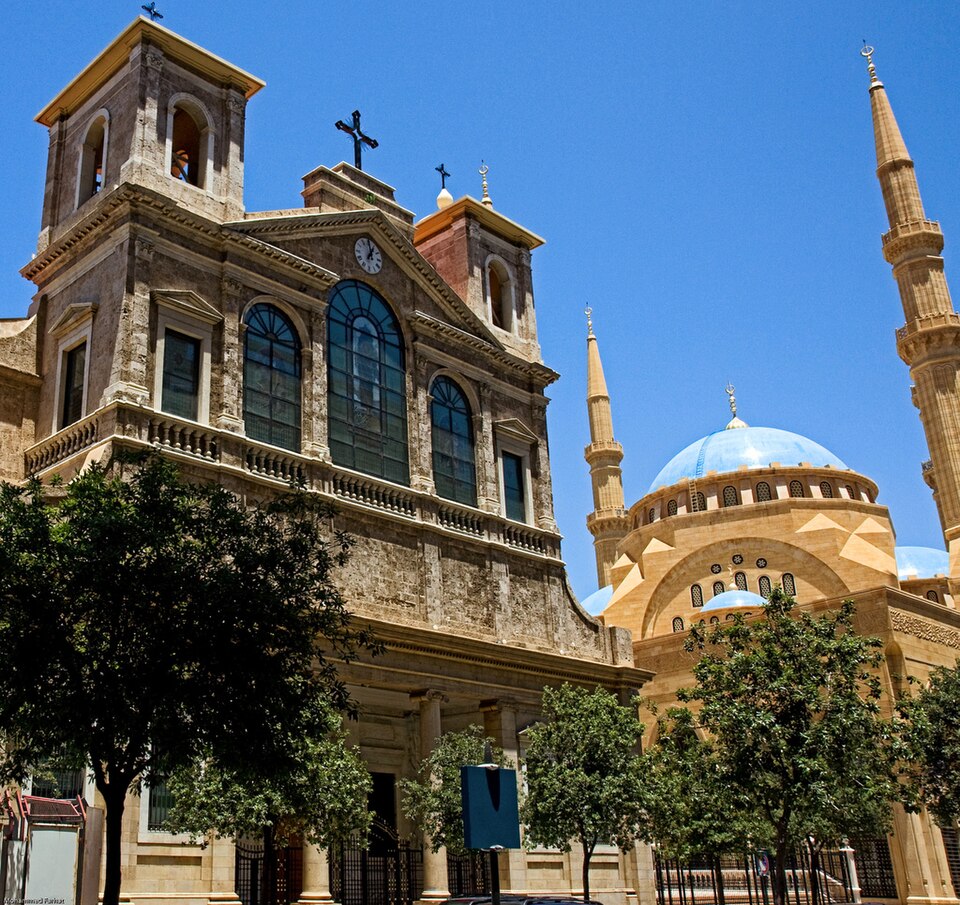
A Neoclassical cathedral with a columned portico modelled on a major Roman basilica, a coffered gilded ceiling and marble and stucco interior, and a 72-metre bell tower added in 2016 to match the height of nearby mosque minarets.
The cathedral of Beirut's Maronite Catholic archeparchy stands on a site occupied since the eighteenth century by an earlier church dedicated to the same saint. Its Neoclassical design draws on a major Roman basilica, with a coffered gilded ceiling and marble and stucco interior. Civil war fighting and the 2020 port explosion both damaged the building, which was restored twice and reopened in 2000. A 72-metre bell tower was added in 2016. Excavations beneath its forecourt have uncovered Hellenistic and Roman-era remains.
- Pope John Paul II's chair from his 1997 visit is kept inside.
- Its 2016 bell tower was built to the same height as nearby mosque minarets, a deliberate gesture of interfaith balance.
- Hellenistic and Roman street remains lie preserved beneath the forecourt.
Photo: Lebnen18 (CC BY-SA 3.0)
Grand Serail
1853
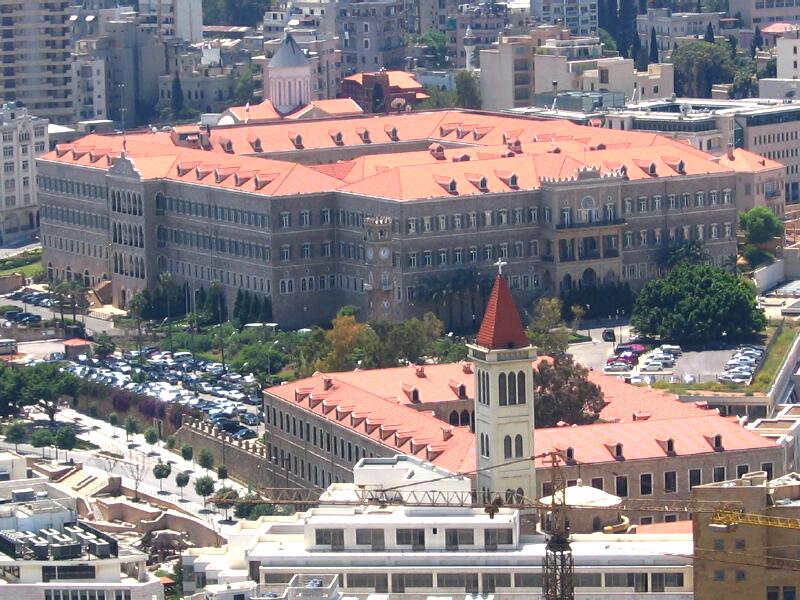
A large government palace occupying the crest of a hill above the downtown core, sharing the high ground with a matching Ottoman-era administrative building and a clock tower from the same period.
Lebanon's prime minister governs from a palace raised in 1853 on high ground above the modern downtown, the most substantial of three Ottoman-era structures sharing Serail Hill, together with the headquarters of the Council for Development and Reconstruction and the Hamidiyyeh clock tower. Built as an Ottoman government building, it kept its administrative role after Ottoman rule ended and later became the seat of the Lebanese Prime Minister. It stands a few blocks from the Lebanese Parliament, within the same government district.
- Two other Ottoman-era structures share the same hill: an administrative headquarters and the Hamidiyyeh clock tower.
Photo: BlingBling10 (CC BY-SA 3.0)
Mohammad Al-Amin Mosque
A Sunni mosque in downtown Beirut, inaugurated in 2008 on the site of a 19th-century zawiya. Nicknamed the Blue Mosque, it rises 72 metres and stands directly beside the Maronite Cathedral of Saint George.
Sursock Museum
A modern and contemporary art museum in Beirut, officially known as the Nicolas Ibrahim Sursock Museum.
Corniche
A palm-lined seaside promenade in Beirut's Central District, with views of the Mediterranean and the peaks of Mount Lebanon. It grew out of the Avenue des Français, built along the old town's seafront during the French Mandate.
National Museum
Lebanon's principal archaeology museum, opened in 1942 in an Egyptian Revival building. It sat on the front line of the 1975 civil war and was badly damaged, but a later renovation restored it, and about 1,300 artifacts are now on display.
Maghen Abraham Synagogue
A synagogue in Beirut's Wadi Abu Jamil district, established in 1925 and damaged by bombardment during the civil war. Restored between 2009 and its reopening around 2014, it was slightly damaged again in the 2020 Beirut explosions.
Beit Beirut
A museum and cultural center on the history of Beirut, with a particular focus on the civil war. It occupies the restored Barakat Building, known as the Yellow House, designed by Youssef Aftimus.
Saint George Greek Orthodox Cathedral
The seat of Beirut's Greek Orthodox Metropolitan bishop, consecrated in 1764. It is the city's oldest standing church, built over the vanished Anastasi Romano-Byzantine cathedral.
Al-Omari Grand Mosque
A mosque in downtown Beirut that began as a Roman temple, then a Byzantine church, before being rebuilt in 635 CE and named for the caliph Umar. Crusaders later converted it into a church, and it became a mosque again after the Mamluk conquest.
Martyrs' Square
Beirut's historic central public square, once known as Al Burj or Place des Cannons. It takes its current name from the executions ordered there by Djemal Pasha on 6 May 1916.
The Egg
An unfinished cinema whose construction began in 1965 and stopped when civil war broke out in 1975, leaving its horseshoe-shaped concrete dome standing as a Beirut landmark. During the 2019-2020 protests it was reused as a gathering place for talks and lectures, nicknamed "eggupation."
Cathedral of Saint Elias and Saint Gregory the Illuminator
An Armenian Catholic cathedral in downtown Beirut's Debbas Square, its construction funded by Pope Pius XI starting in 1928. It serves as the seat of the Armenian Catholic Patriarchate of Cilicia and draws architectural inspiration from Rome.
Sourp Nshan Cathedral
An Armenian Apostolic cathedral on Serail Hill, next to the Grand Sérail, seat of the Armenian Apostolic Diocese of Lebanon. Its parish registers survive from 1863, the oldest continuously kept Armenian church records in the country.
Museum of Lebanese Prehistory
A museum of prehistory and archaeology in Beirut, Lebanon.
Roman Forum
Roman-era forum ruins located in downtown Beirut.
Hippodrome of Berytus
A Roman-era circus built in the ancient colony of Berytus, one of two hippodromes known to have stood in the city.
Horsh Beirut
An urban park in central Beirut also known as Horsh El Snaubar, or Bois de Pins. It covers about 0.3 square kilometres of pine woodland within the municipal city.
Camille Chamoun Sports City Stadium
A multi-purpose stadium in Beirut's Bir Hassan area, seating 49,500 and equipped with athletics facilities. It is the largest stadium in the country and is used mainly for football matches.
Saint Louis Cathedral of the Capuchin Fathers
A small Latin Catholic cathedral and convent built by Capuchin missionaries in 1864, on the slope of Serail Hill beside Bab Idris, one of Beirut's historic gates. Named for King Louis IX of France, it is known for its tall campanile.
Moussa Sursock Palace
A 19th-century mansion completed in the late 1870s for Moussa Dimitri Sursock, one of the largest and best-preserved private residences in Beirut. Its castle-like towers and Italianate design house a fine art collection, including works by Artemisia Gentileschi, damaged by the 2020 port explosion.
Ziade Palace
A 19th-century grand mansion in Beirut's Zokak el-Blat quarter.
Holiday Inn Beirut
A high-rise hotel on Omar Daouk Street overlooking the Corniche seafront. It operated for less than a year before closing in 1975 when the civil war broke out, and has stood ruined ever since.
St. Georges Hotel
A resort hotel opened in 1934 and designed by the Parisian architect Auguste Perret with the local architect Antun Tabet. Its glamorous 1960s heyday drew guests from Brigitte Bardot to Kim Philby before it closed in 1975 amid the civil war.
Beirut Castle
A major Crusader-era castle that once stood in downtown Beirut. It was demolished in the late 19th century to make way for the expansion of the Port of Beirut.
Riad Al Solh Square
A public square in the heart of downtown Beirut.
History
Beirut has been settled for more than five thousand years, yet little of that depth remains visible; repeated rebuilding has left only fragments, among them the Roman bath complex uncovered in today's downtown. The most enduring civic architecture dates from Ottoman rule, including the government palace raised on Serail Hill in 1853, still in use as the prime minister's seat alongside two other Ottoman-era buildings on the same rise. Religious building continued as Ottoman control eased, with a Maronite cathedral built between 1884 and 1894 over the site of an eighteenth-century predecessor. The twentieth and twenty-first centuries then brought the heaviest damage: civil war, the 2006 war and the 2020 port explosion, each followed by restoration that explains why the surviving landmarks look their age unevenly.