Landmarks in Antalya
A Roman gate and a Seljuk minaret stand within a few streets of the old harbour quarter.
Antalya's oldest survivors cluster around the walled old town that grew up above its harbour. Two come from the Roman centuries: a triumphal arch raised for the emperor Hadrian's visit in 130 CE, later folded into the town's defensive walls as their only surviving gate, and a tawny-stone tower where those walls now meet a seafront park, dated to about the same era and classified as a possible lighthouse. The third marks a change of rulers: a brick minaret cut into deep flutes and once glazed with blue tile, raised in 1230 in the Seljuk style, a few decades after the Seljuk Empire took the city in 1207. Together the three trace the shift from Roman garrison town to medieval Anatolian city.
Hadrian's Gate
130
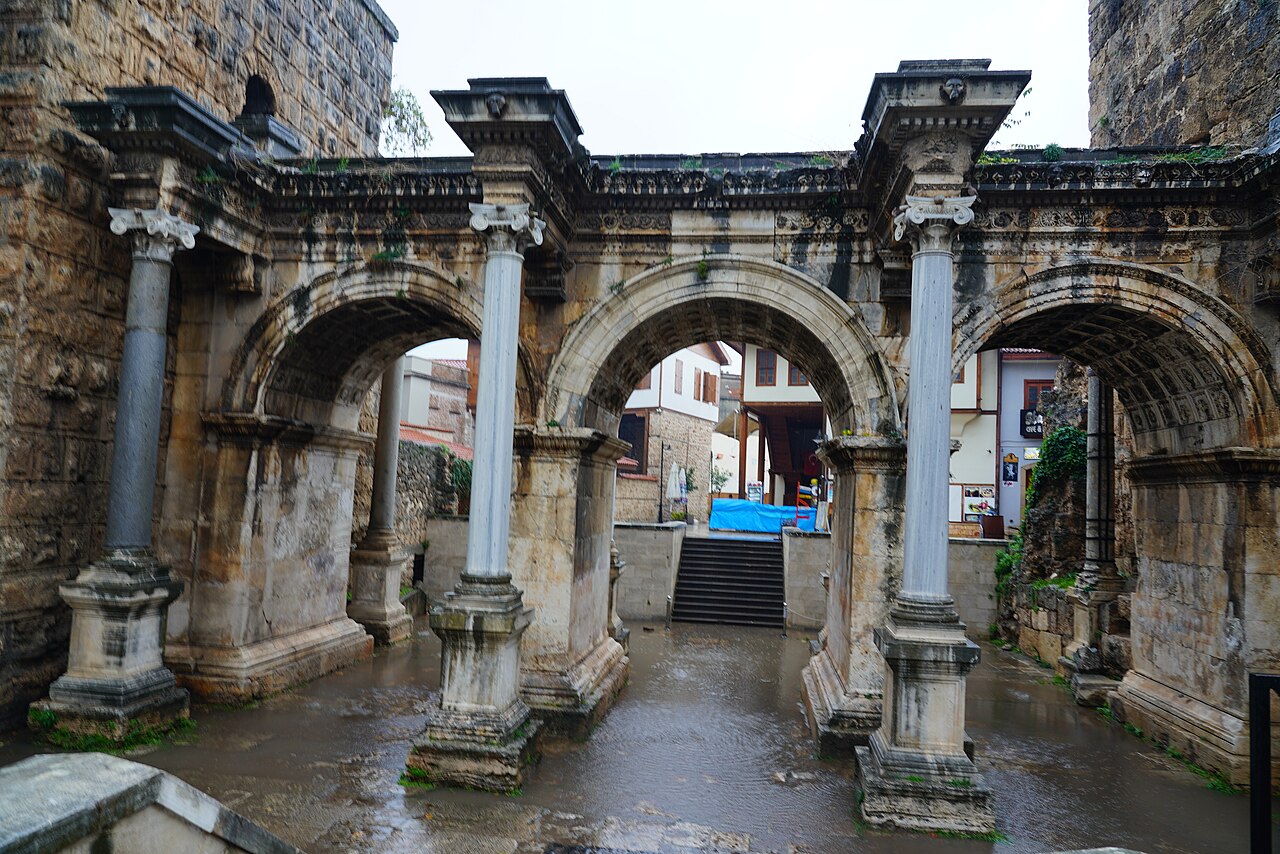
Three round-arched openings sit side by side in a short stretch of ancient wall — the last complete gateway left from the old fortifications, still spanning the road into the historic quarter.
Hadrian's Gate was raised in 130 CE to mark a visit by the Roman emperor Hadrian and was later built into the walls encircling the city and its harbour. It is the only one of those old gates to survive complete, having been rediscovered in 1817 by the Irish hydrographer Francis Beaufort while he commanded the ship HMS Fridericksteen. Today it still spans the road leading into the old town, its three round arches marking the main historic entrance.
- It was rediscovered in 1817 by the Irish hydrographer Francis Beaufort, while he commanded HMS Fridericksteen.
- Its Turkish name, Üçkapılar, translates as "The Three Gates."
Photo: Ray Swi-hymn from Sijhih-Taipei, Taiwan (CC BY-SA 2.0)
Yivli Minaret
1230
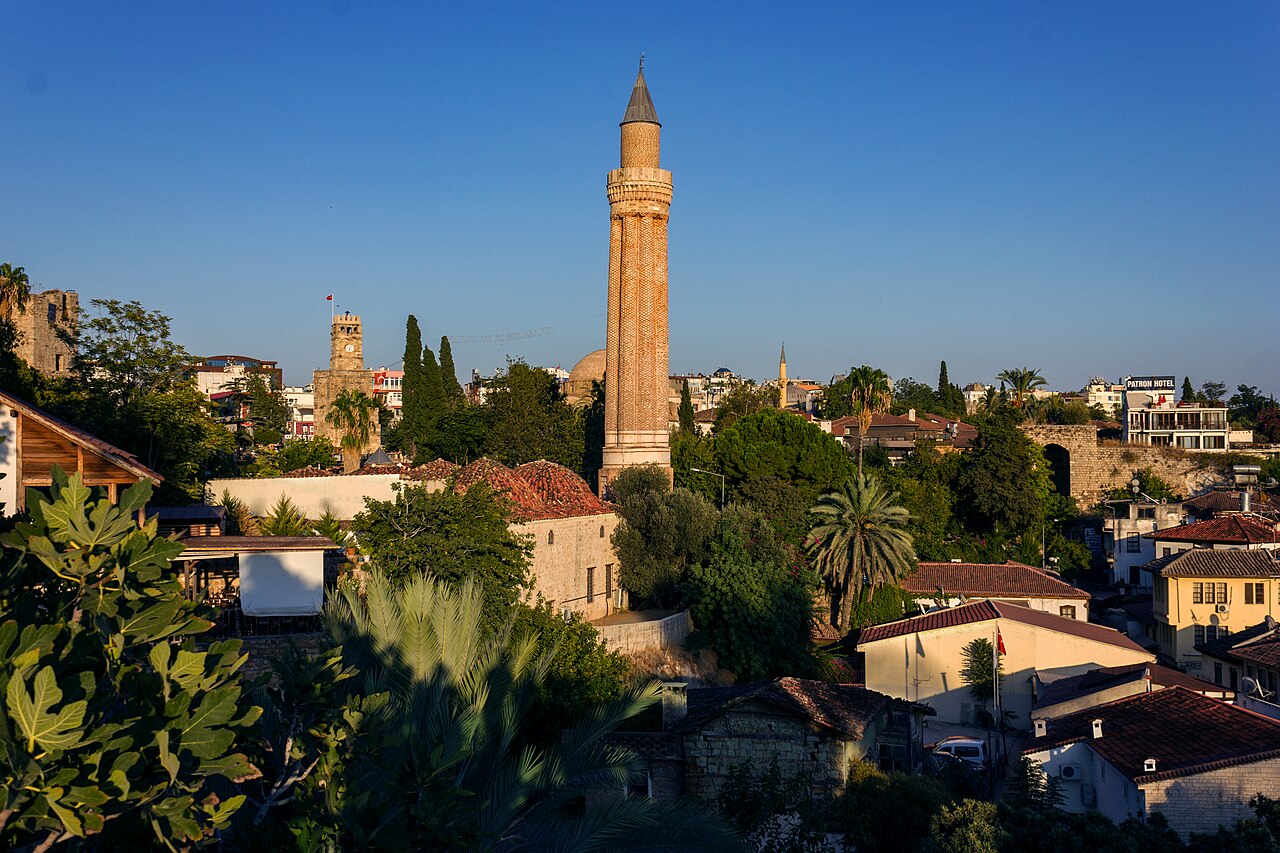
The minaret's brick shaft is carved into deep vertical flutes, with a few patches of turquoise tile still clinging near the top — a grooved silhouette that has become one of the clearest visual symbols of Antalya.
The Yivli Minaret Mosque stands in Kaleiçi, Antalya's old town, on Cumhuriyet Street near Kalekapısı Square. Built in 1230 in the Seljuk style, it takes its name from the deep flutes cut into its brick minaret, some still showing patches of blue tile. It is counted among the city's most important monuments and has been placed on Turkey's tentative list for UNESCO World Heritage status. The minaret's grooved profile has made it one of the city's most widely recognised structures.
- It is on Turkey's tentative list for UNESCO World Heritage status.
Photo: Bestalex (CC BY-SA 4.0)
Hidirlik Tower
200
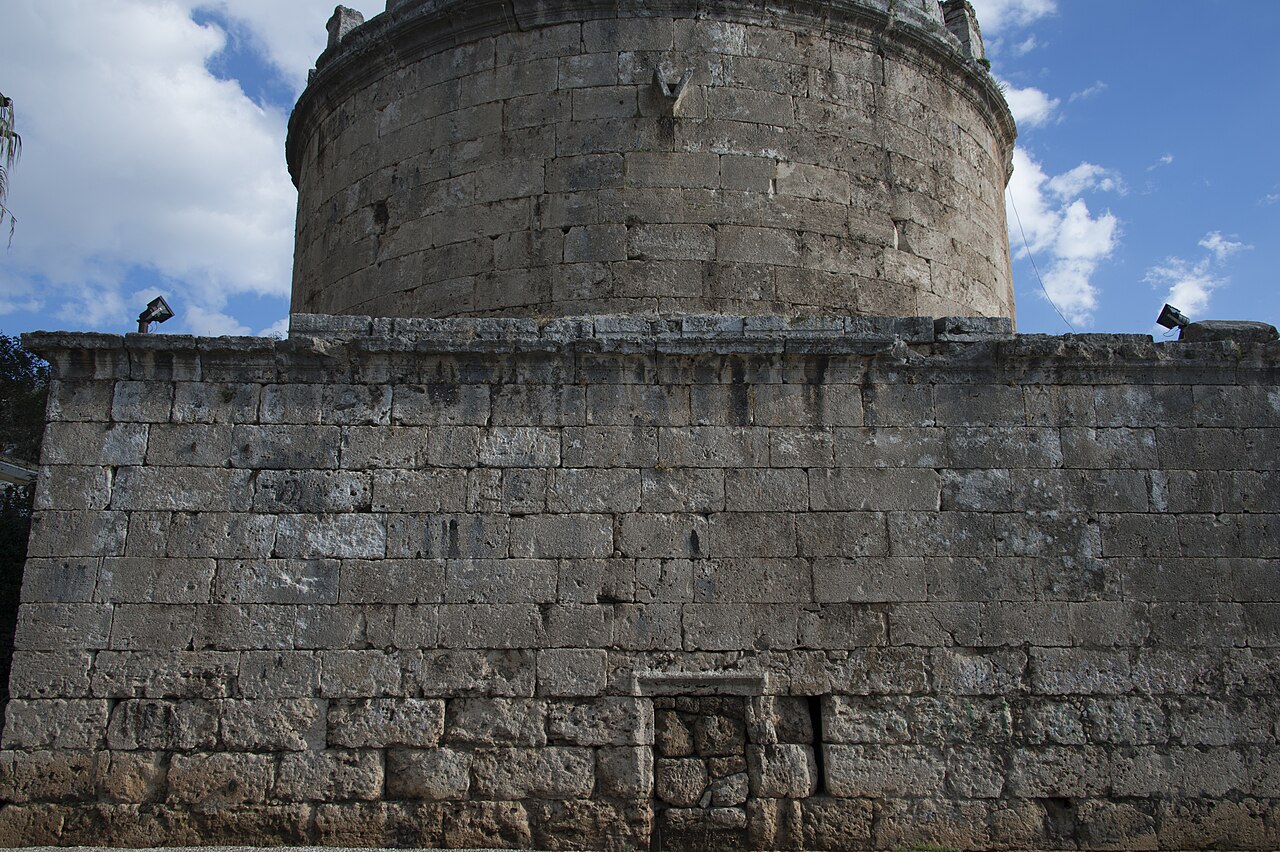
A squat cylindrical tower built of tawny-coloured stone, standing right where the old walled quarter meets a seafront park — one of the plainest and most weathered of the city's ancient structures.
Hıdırlık Tower is a round tower of tawny-coloured stone standing at the point where Antalya's old walled quarter meets a park above the sea. It is classified as both a tower and a lighthouse, though little more is recorded of its original use. Its construction is dated to around 200, placing it within the same Roman centuries that produced Hadrian's Gate nearby. No heritage listing or architect is recorded, and it is one of the more modest survivors among the city's ancient structures, distinguished mainly by its position and the colour of its stone.
Photo: Dosseman (CC BY-SA 4.0)
Düden Waterfalls
Two waterfalls formed by the Düden River in Antalya province, Turkey.
Glass Pyramid Sabancı Congress and Exhibition Center
A glass-pyramid convention complex with five halls, including one seating 2,400, plus a 15,000-square-metre open-air exhibition area. Built by the Sabancı Foundation, it opened on October 1, 1997, and its usage rights later passed to the Antalya municipality.
History
The city began as Attaleia, founded around 200 BC by Attalus II of Pergamon, and was soon absorbed into the Roman world. Roman rule brought new construction, including the arch raised for Hadrian's visit in 130 CE, while nearby Pamphylian and Lycian cities flourished alongside it. Control passed to the Seljuk Empire in 1207, a shift that left its mark in the fluted, tile-glazed minaret raised a few decades later, and then to the Ottomans in 1391, who held the city for the next five hundred years. Italy occupied it for three years after the First World War before it returned to Turkey during the War of Independence. Each period added its own layer without erasing the last, which is why Roman and Seljuk structures still stand within a few streets of each other.