Landmarks in San Francisco
Two Beaux-Arts monuments of 1915 flank a record-breaking suspension bridge of 1937.
San Francisco's landmarks cluster into two short building periods. The 1906 earthquake and fire destroyed three-quarters of the city, and the recovery produced the Panama–Pacific International Exposition of 1915, which left the Palace of Fine Arts, an ornamental rotunda and lagoon in the Marina District since rebuilt, and the domed, Beaux-Arts San Francisco City Hall in the Civic Center, replacing a hall lost in the quake. Two decades on, the Golden Gate Bridge closed the mile-wide strait at the peninsula's northern tip in steel rather than stone or plaster. Read together, the three trace a city that rebuilt itself twice: first in ornamental classicism, then in structural steel.
Golden Gate Bridge
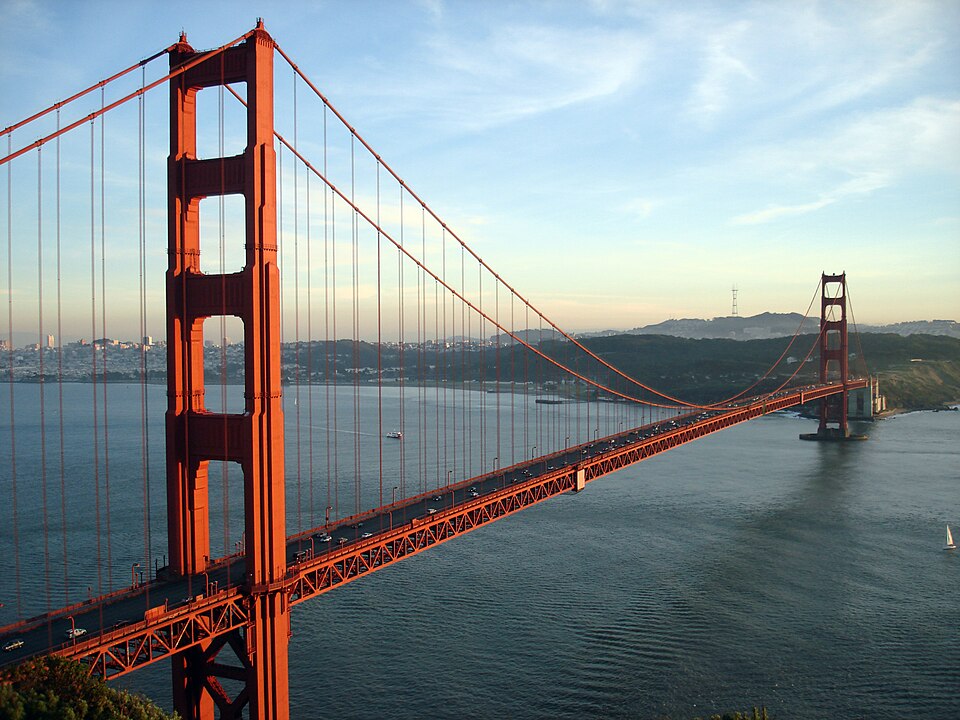
1937 · Joseph Strauss
The bridge links the tip of a peninsula to a hilly county to the north, its deck carrying U.S. Route 101 and California State Route 1 on tall trestle-style towers set a mile apart across open water. Cables sweep down from each tower in a continuous curve to the roadway, which also carries a separate pedestrian and bicycle path.
The Golden Gate Bridge is a steel suspension bridge carrying a coastal highway and pedestrian and bicycle traffic across a mile-wide strait linking a bay to the ocean. Joseph Strauss served as chief engineer, with Leon Moisseiff, Irving Morrow and Charles Ellis making significant contributions to the design. It opened on May 27, 1937, when it was both the longest and the tallest suspension bridge in the world, and has since undergone various retrofits and improvement projects. It is recognized by the American Society of Civil Engineers as one of the Wonders of the Modern World.
- It carries a numbered cycling route, U.S. Bicycle Route 95, alongside its car lanes.
- At its 1937 debut it was simultaneously the tallest and the longest suspension bridge in the world.
Photo: Rich Niewiroski Jr. (CC BY 2.5)
Palace of Fine Arts
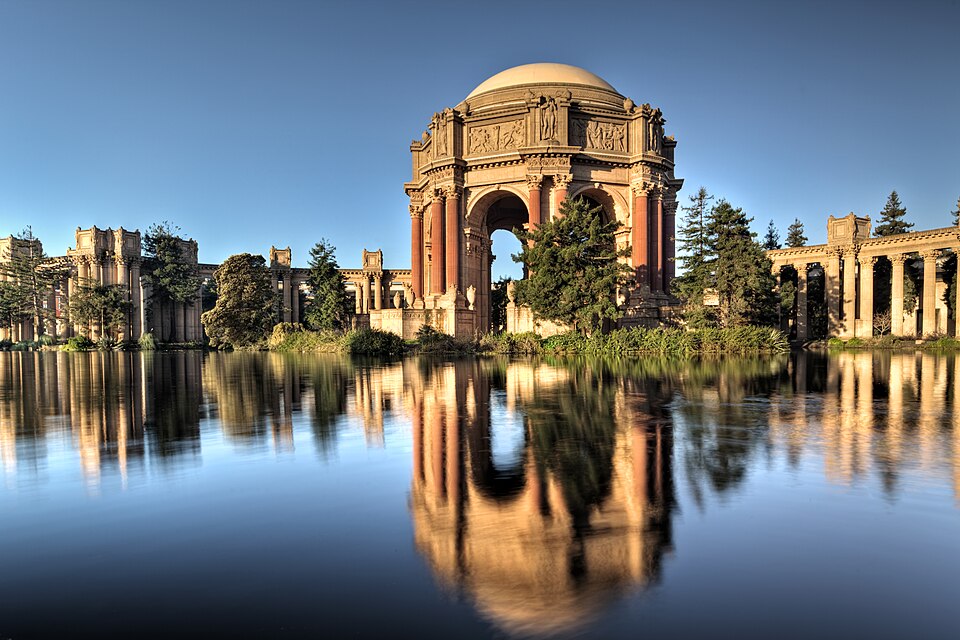
1915–1974 · Bernard Maybeck
A domed, freestanding rotunda about 49 metres high stands beside a curved lagoon, separated by open colonnades from a long, curved single-story exhibition hall behind it. The whole composition borrows Roman and Greek architectural forms in a Beaux-Arts arrangement, built from the outset to look aged rather than new.
The Palace of Fine Arts is a monumental structure in the Marina District, built for the 1915 Panama–Pacific International Exposition to display works of art. Conceived by Bernard Maybeck to evoke a decaying Roman ruin, its 162-foot-high open rotunda is enclosed by a lagoon on one side and adjoins a large, curved exhibition center on the other, separated from the lagoon by colonnades. It is the only structure from the exposition to survive on its original site, having been completely rebuilt between 1964 and 1974. The lagoon, walkways and structure itself were renovated and seismically retrofitted by 2009.
- It is the only structure from the 1915 exposition still standing on its original site.
- Its rotunda was designed from the start to look like a crumbling ancient ruin, not a new building.
- The exhibition hall beside it is now used for weddings and trade fairs.
Photo: Kevin Cole (en:User:Kevinlcole) (CC BY 2.0)
San Francisco City Hall
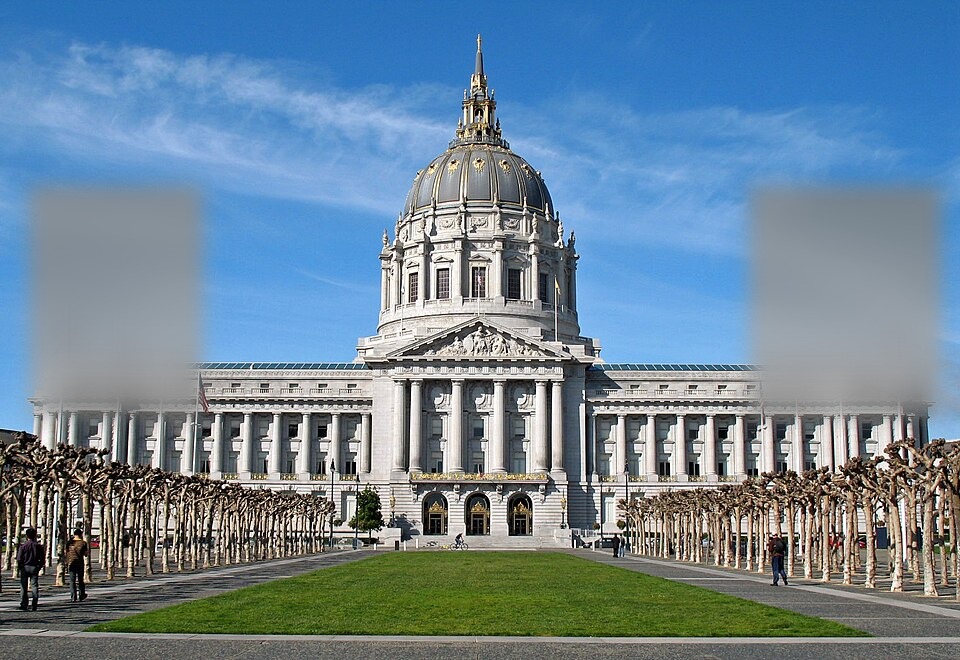
1915 · Arthur Brown, Jr.
A large ribbed dome, standing taller than that of the United States Capitol by about 13 metres, crowns a symmetrical Beaux-Arts facade with colonnades, set within a formal civic square. Details as small as the doorknobs and the signage lettering were designed to match the whole.
San Francisco City Hall is the seat of government for the City and County of San Francisco, re-opened in 1915 in the Civic Center as a Beaux-Arts monument to the City Beautiful movement. Its dome stands 42 feet taller than that of the United States Capitol. The building replaced an earlier City Hall, two blocks away, destroyed in the 1906 earthquake. Principal architect Arthur Brown, Jr., of Bakewell & Brown, attended to details down to the doorknobs and signage typeface; he also designed the city's War Memorial Opera House, Veterans Building, Temple Emanuel and Coit Tower.
- Its dome is taller than that of the United States Capitol by about 13 metres.
- The architect specified the design down to the doorknobs and the signage typeface.
Photo: Sanfranman59 (CC BY-SA 3.0)
Cathedral of Saint Mary of the Assumption
The city's third Catholic cathedral, completed in 1970 in the Cathedral Hill neighborhood as the principal church of the Archdiocese. It replaced an 1891 building destroyed by fire in 1962, while the first, dating to 1854, survives today as Old Saint Mary's Cathedral.
Ghirardelli Square
A landmark public square at the foot of Russian Hill, near Fisherman's Wharf. Part of it was listed on the National Register of Historic Places in 1982 as the Pioneer Woolen Mills and D. Ghirardelli Company, once home to more than 40 specialty shops.
Pier 39
A shopping center and tourist attraction built on a pier at the edge of Fisherman's Wharf, known for its resident California sea lions and the Aquarium of the Bay. Its attractions include a two-story carousel and Magowan's Infinite Mirror Maze.
Conservatory of Flowers
A greenhouse and botanical garden in Golden Gate Park, completed in 1879 and now the oldest building in the park. It is the oldest surviving municipal wooden conservatory in the country, and one of three sites making up the Gardens of Golden Gate Park.
De Young Museum
A fine arts museum in Golden Gate Park, named for early San Francisco newspaperman M. H. de Young. It is paired with the Legion of Honor, and drew 999,645 visitors in 2023, ranking as the 22nd most-visited museum in the United States.
California Academy of Sciences
A research institute and natural history museum in Golden Gate Park, among the largest of its kind in the world with more than 46 million specimens. Founded in 1853 as a learned society, it was completely rebuilt in 2008 into a 400,000-square-foot building.
Fort Point National Historic Site
A masonry seacoast fortification at the entrance to San Francisco Bay, first fortified by the Spanish in 1794. The current structure, completed by the U.S. Army just before the Civil War, now sits beneath the Golden Gate Bridge as a National Historic Site.
Fairmont
A luxury hotel atop Nob Hill, named for mining magnate and U.S. Senator James Graham Fair by the daughters who built it in his honor. It was the founding hotel of the Fairmont chain, and its $21,000-a-night, 1927 penthouse suite has hosted several U.S. presidents.
City Lights Bookstore
An independent bookstore and publisher founded in 1953 by poet Lawrence Ferlinghetti and Peter D. Martin, specializing in world literature and progressive politics. It became widely known after Ferlinghetti's 1956 obscenity trial for publishing Allen Ginsberg's Howl and Other Poems.
Peace Pagoda
A five-tiered concrete stupa in Japantown's Peace Plaza, designed by Japanese architect Yoshiro Taniguchi and built in the 1960s. It was presented to the city by its sister city, Osaka, Japan, on 28 March 1968.
Congregation Emanu-El
One of the three oldest Jewish congregations in California and one of the largest in the United States. A member of the Union for Reform Judaism, it serves as a significant gathering place for the Bay Area's Jewish community.
The Fillmore
A historic music venue in Western Addition, built in 1912 as the Majestic Hall before becoming the Fillmore Auditorium in 1954. Since 2007 it has been operated by Live Nation, which has named or renamed other venues after it.
Presidio
A former U.S. Army post on the peninsula's northern tip, fortified since 1776 when New Spain established it, passing to Mexico in 1820 and the United States in 1848. It ended 219 years of military use when transferred to the National Park Service in 1994.
Congregation Sherith Israel
A Reform Jewish congregation founded in 1851 during the Gold Rush, among the oldest synagogues in the United States. Its sanctuary, completed in 1905 and listed on the National Register of Historic Places, was also a principal site of the San Francisco graft prosecution trials.
Asian Art Museum
A museum specializing in Asian art, with its building and permanent collection owned by the City of San Francisco.
Pioneer Monument
A granite monument with bronze figures and reliefs by sculptor Frank Happersberger, financed by the estate of James Lick and dedicated on 29 November 1894. Its controversial component, known as Early Days, was removed in 2018.
Haas–Lilienthal House
A Victorian house built in 1886 in Pacific Heights for William and Bertha Haas, which survived the 1906 earthquake and fire. Donated in 1973 to the nonprofit San Francisco Heritage, it was converted into a museum drawing more than 6,500 visitors a year.
Civic Center Plaza
A 4.53-acre plaza immediately east of City Hall, divided into a north and south block by the former alignment of Fulton Street. The north block sits atop a three-story parking garage completed in 1960, and the south over the former exhibition space, Brooks Hall.
Alcatraz Island Lighthouse
The first lighthouse built on the U.S. West Coast, completed in 1854 on Alcatraz Island. It was replaced in 1909 by a taller concrete tower after the original was damaged in the 1906 earthquake, and was automated in 1963, the year the prison closed.
USS Pampanito
A Balao-class submarine built for the U.S. Navy during World War II, completing six war patrols between 1944 and 1945. After serving as a Naval Reserve training ship until 1971, it became a National Historic Landmark and is now a museum ship at Fisherman's Wharf.
Maritime National Historical Park
A park with a fleet of historic vessels, a maritime museum and a research library, its collections acquired by the National Park Service in 1978. Authorized in 1988, it also incorporates the Aquatic Park Historic District.
Bill Graham Civic Auditorium
A multi-purpose arena named after concert promoter Bill Graham, formerly known as the San Francisco Civic Auditorium. It holds up to 8,500 people.
Fort Mason
A former U.S. Army post in the Marina District, serving from the Civil War era as a coastal defense site and later as a military port. It was the principal port for the Pacific campaign during World War II.
History
Before European settlement, the peninsula was home to the Yelamu Ohlone. Spanish settlers established the Presidio of San Francisco at the Golden Gate and the Mission San Francisco de Asís nearby on June 29, 1776, both named for Francis of Assisi. The 1849 gold rush made the settlement the largest city on the West Coast almost at once, and in 1856 it became a consolidated city-county. Three-quarters of the city was destroyed in the 1906 earthquake and fire; rebuilding was fast enough to host the Panama–Pacific International Exposition just nine years later, in 1915, the year both the Palace of Fine Arts and the rebuilt City Hall opened. The Golden Gate Bridge followed in 1937. In the Second World War the city served as a major port of embarkation for Pacific-bound naval service members.