Landmarks in Quito
A colonial cathedral, a neoclassical palace, and a basilica share one historic square.
Quito's landmarks sit within a few blocks of each other in the historic center, around Independence Square, rather than scattered across the metropolitan area. A Gothic-style cathedral and a neoclassical government palace face one another across the square, joined by an archbishop's residence, a municipal hall, and a hotel that complete the same colonial-era ensemble. A short walk away stands a Gothic Revival basilica, reaching roughly 83 metres, added to the core in the early twentieth century rather than the colonial period. The result is a compact, low-rise cluster of stone and masonry construction spanning the sixteenth to the twentieth centuries, set on the eastern slopes of an active volcano at high elevation.
Basilica of the National Vow
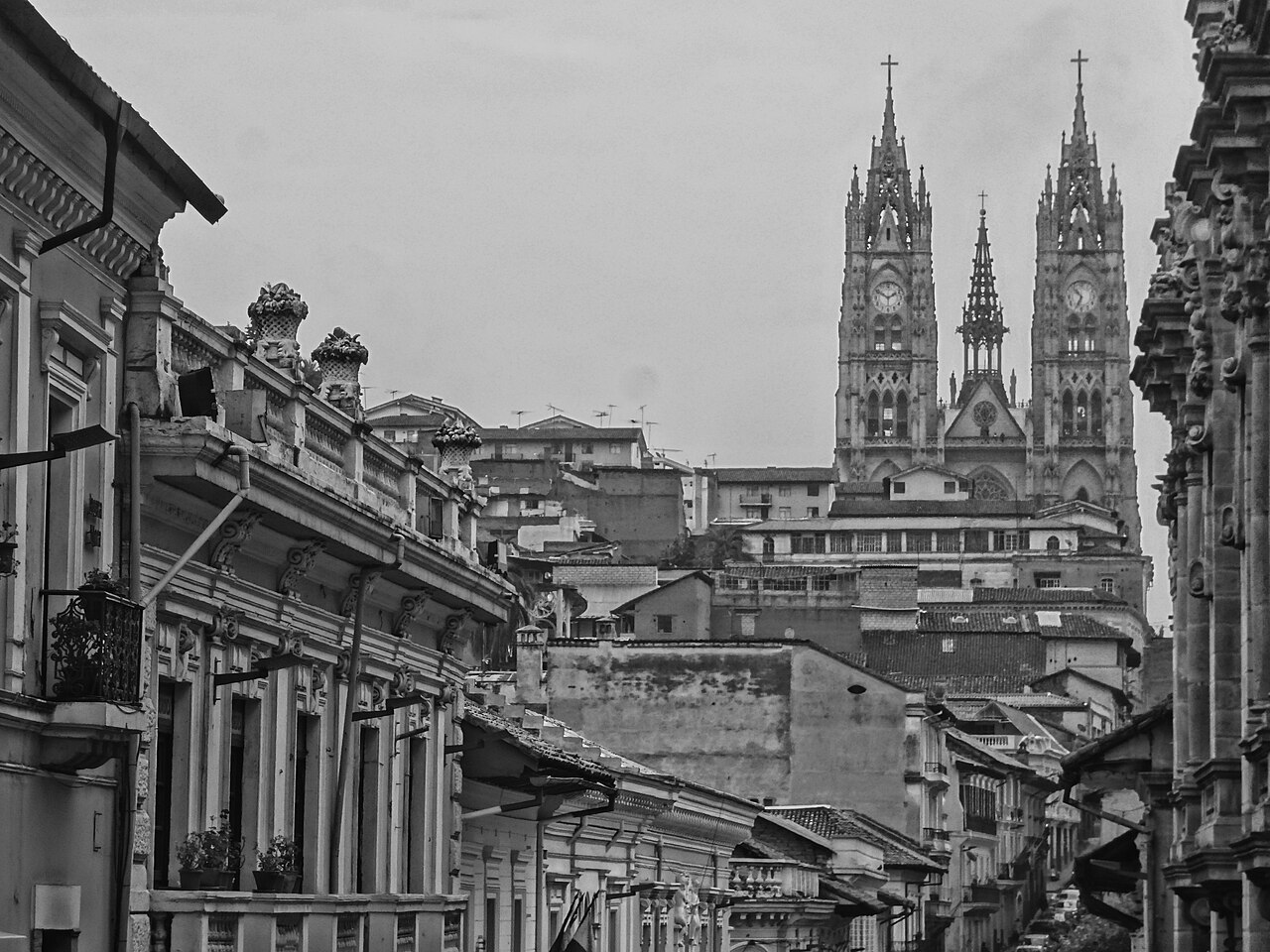
1924
A Gothic Revival profile reaching roughly 83 metres, taller than anything else in the low, colonial-era streets around it.
A Roman Catholic church built in the Gothic Revival style, completed in 1924 in the historic center. Its structure reaches up to 83 metres, among the tallest built in that part of the city. No individual designer is recorded for it in the available record, and it remains an active place of worship rather than a converted or secular building. It stands within walking distance of the city's colonial-era cathedral and government palace, adding a later, taller silhouette to an otherwise low-rise historic core.
Photo: Quito magnífico (shifted by Rabanus Flavus) (CC BY-SA 4.0)
Quito Metropolitan Cathedral
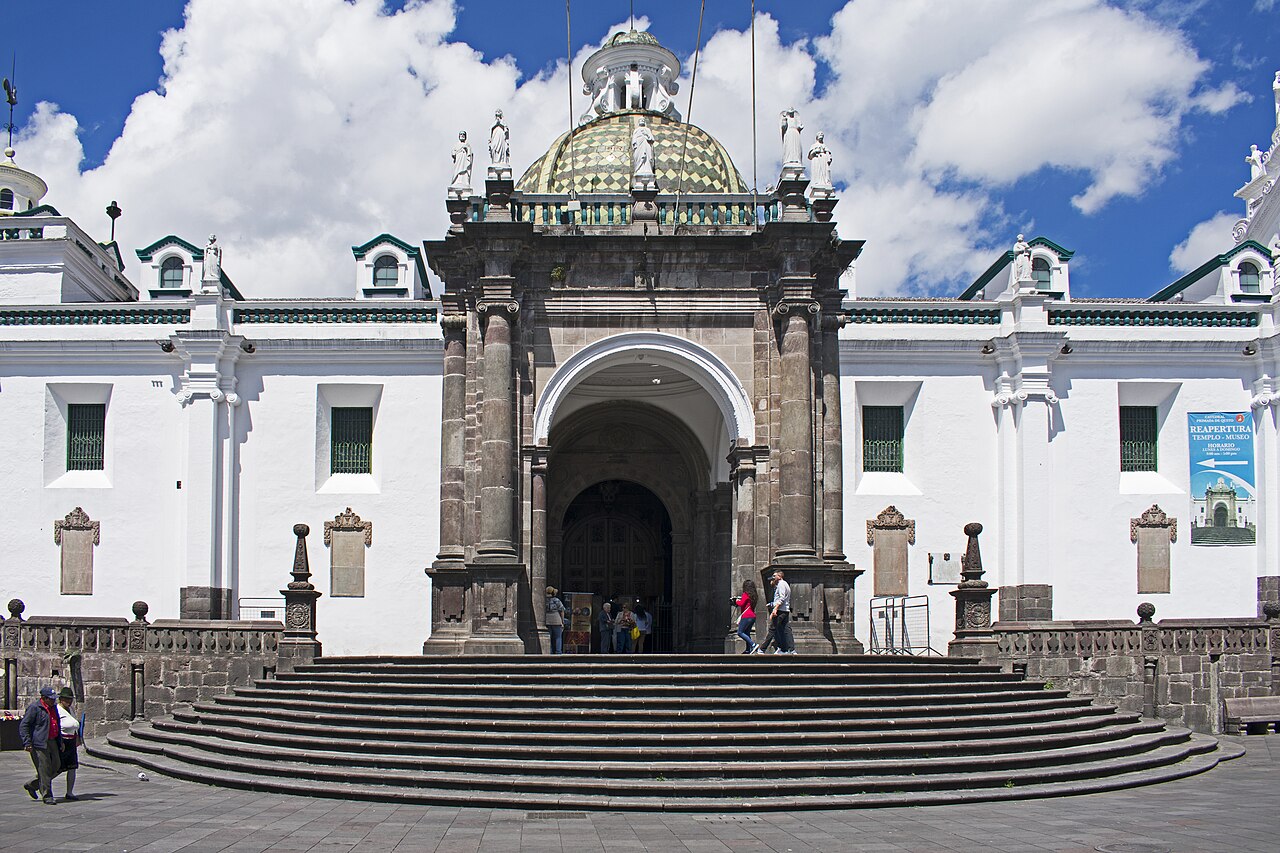
1567
A Gothic-style cathedral standing on one side of a main square, facing the seat of government directly across it, with an archbishop's residence and a town hall completing the plaza on the other sides.
A Gothic-style Catholic cathedral on the southwestern side of Independence Square, its current structure dating to 1567. It and its predecessor building served as the seat of the Diocese of Quito from 1545 until 1848, when the diocese was elevated to an archdiocese. No individual architect is recorded for it. The Archbishop's Palace, the Municipal Palace, a hotel, and the government palace all face the same square, forming a single colonial-era ensemble in the historic center.
- In 1995 it was elevated again, to become the seniormost Catholic church in the country.
Photo: Ángel M. Felicísimo (CC BY-SA 4.0)
Carondelet Palace
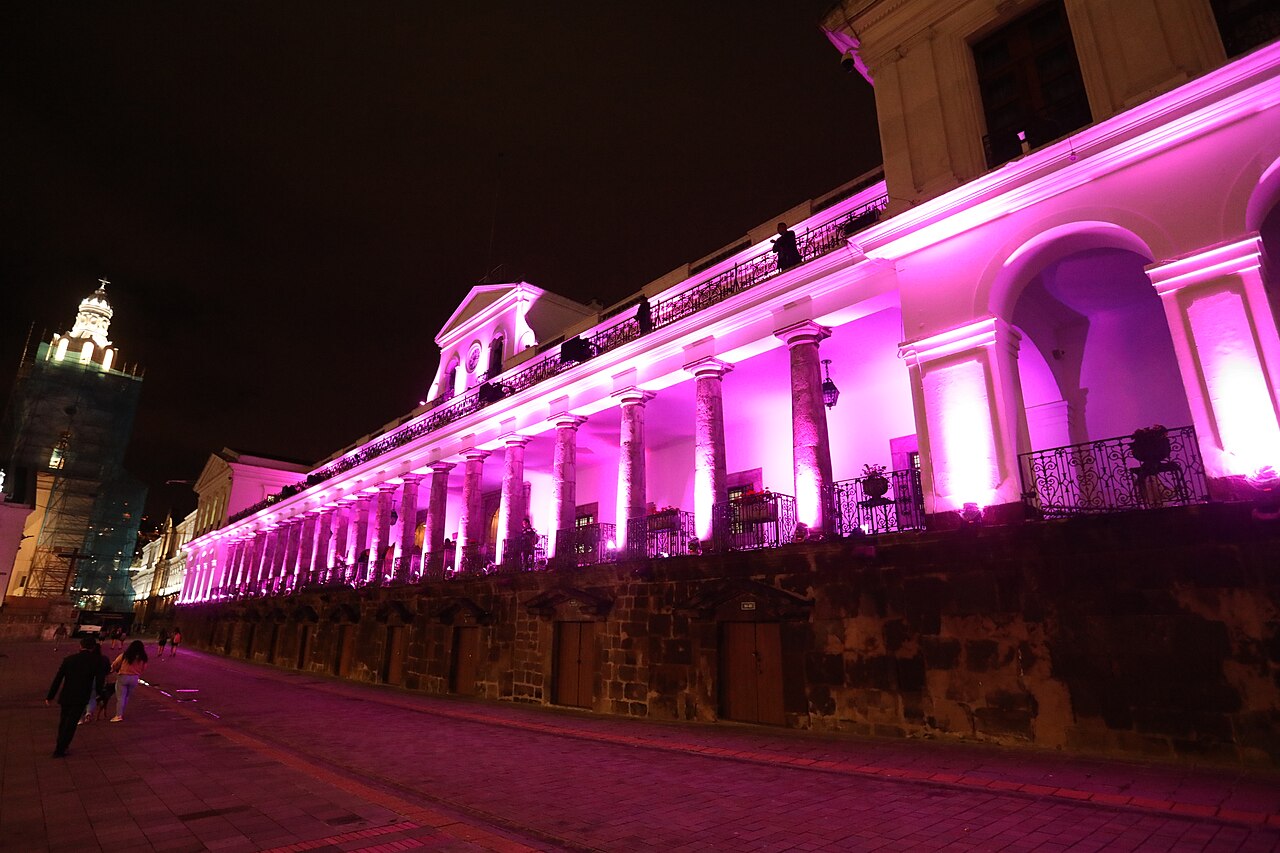
1801
A Neoclassical palace with Spanish Colonial detailing, fronting the same main square as a Gothic-style cathedral, an archbishop's residence, a town hall, and a hotel.
The seat of government of the Republic of Ecuador, built in 1801 in a Neoclassical style with Spanish Colonial features. It faces Independence Square, alongside the Archbishop's Palace, the Municipal Palace, a hotel, and the Metropolitan Cathedral, together forming the square's colonial-era ensemble. No individual architect is recorded for the building. Access to it is through the public space of the square itself, which remains the administrative center around which the historic core is arranged.
- The square it fronts is officially named Independence Square but is commonly known instead as Plaza Grande.
Photo: Taty2007 (CC BY 3.0)
Church of La Compañía
A Jesuit church and convent complex in Quito's Historic Center, its façade entirely carved from volcanic stone. Nicknamed the "Temple of Solomon of South America," it grew from a colonial-era compound that once housed a seminary and the University of San Gregorio Magno.
Basilica and Convent of San Francisco
A Catholic basilica and convent fronting its own square in Quito's historic center, the oldest and most significant religious site in Ecuador. Built over more than 150 years and covering some 40,000 square metres, it is the largest colonial architectural complex in South America, once known as "El Escorial of the New World."
Virgin of El Panecillo
A 41-metre statue crowning the loaf-shaped hill of El Panecillo, above Quito's historic center. It is the tallest statue in Ecuador, taller than the Christ the Redeemer statue in Rio de Janeiro, and the tallest aluminum statue in the world.
La Carolina Park
A 165.5-acre park in the center of Quito's business district, bounded by the avenues Río Amazonas, de los Shyris, Naciones Unidas, Eloy Alfaro and de la República. Two metro stations, Iñaquito and La Carolina, sit at its northern and southern ends.
Basilica of La Merced
A white Catholic basilica in Quito's Historic Center, begun in 1701 and consecrated in 1737, the first church of the Mercedarian Order in Ecuador. Its five domes and tower are decorated with Inca and Arabic inscriptions, and its altarpiece was carved by Bernardo de Legarda between 1748 and 1751.
Iglesia de El Sagrario
A Renaissance-style Catholic church on calle García Moreno in Quito's Historic Center. Though technically part of the Metropolitan Cathedral complex, its size and artistic importance give it the character of an independent church.
Church and Convent of San Agustín
A Catholic temple and convent run by the Augustinian Order, on calle Chile in Quito's Historic Center.
Parque Bicentenario
A 125-hectare park in northern Quito, built on the grounds of the city's old airport and opened to the public on April 27, 2013. It overtook La Carolina Park to become the largest green space in the city.
Parque El Ejido
A public park along Avenida Patria in Quito's Old Centre, the third-largest park in the city. It hosts art exhibitions on weekends and sits near the Estadio El Ejido.
Centro de Convenciones Bicentenario
Quito's main convention center, a complex of municipally owned buildings occupying the former terminal of the old Mariscal Sucre Airport. It stands surrounded by Bicentenario Park in the La Concepción parish, north of the city center.
City Museum
A museum founded in 1998 in the former San Juan de Dios Hospital, a UNESCO World Heritage building restored in 1995 using its original materials. Its stone Doric columns and courtyards now house exhibition halls chronicling both the city's history and 400 years of the hospital's own past.
Quito Astronomical Observatory
One of the oldest observatories in South America, founded in 1873 and located just south of the Equator in Quito's Historic Center. Now run by the National Polytechnic School, it serves as the National Observatory of Ecuador.
La Alameda Park
Quito's oldest park, a triangular 6.3-hectare space whose layout dates back to 1596 and which is also known as Chuquihuada. It houses the Quito Astronomical Observatory, established here in 1864 as the first astronomical observatory in South America, along with monuments to the French Geodesic Mission and Simón Bolívar.
National Museum of Ecuador
Ecuador's national museum of archaeology and art, originally established by the Central Bank of Ecuador in 1969 and renamed in 2010 when its holdings passed to the Ministry of Culture. Its collection exceeds 70,000 objects, a small fraction displayed at the House of Ecuadorian Culture in Quito.
Ecuador National Museum of Medicine
A museum of medicine located in Quito, Ecuador.
Quito Botanical Garden
An 18,600-square-metre botanical garden, arboretum and greenhouse in Quito. It showcases native plant species from a country that ranks among the world's 17 richest in native flora, with some 17,000 classified species.
Quito Ecuador Temple
A Latter-day Saint temple in Cumbayá, just east of Quito, the church's second temple in Ecuador after Guayaquil. Its groundbreaking took place on May 11, 2019, and it was dedicated the same day as the Belém Brazil Temple.
History
Sedentary populations settled the site as early as 4400 BC, long before the Inca Empire absorbed the region in the late fifteenth century. Spanish colonization followed, and a cathedral on the main square served as the seat of a Catholic diocese from 1545; the building standing today dates to 1567, and in 1995 it was raised to the seniormost Catholic church in the country. Government building continued into the early republic: the neoclassical palace on the same square was built in 1801 and still serves as the seat of national government. The historic core gained one more major structure in the twentieth century, when a Gothic Revival basilica was completed in 1924, adding a soaring, church-spire silhouette to a skyline otherwise built low and close to the ground.