Landmarks in Munich
A citywide height cap keeps a medieval cathedral's towers above everything built after it.
Munich's landmarks fall into three building phases stacked on top of each other. A late-medieval Gothic cathedral anchors the historic core, its twin towers protected by a citywide law that has kept new construction under 100 meters since a narrow public vote decades ago. Around it, the ruling Wittelsbachs left a run of Baroque work: a huge western summer palace with a garden front wider than Versailles, and a yellow, Italian-styled parish church built as thanks for a royal birth. The nineteenth century added a Gothic Revival town hall on the main square and a Neoclassical triumphal arch marking a boulevard's junction with outlying districts, both raised once the city had outgrown its medieval footprint.
New Town Hall
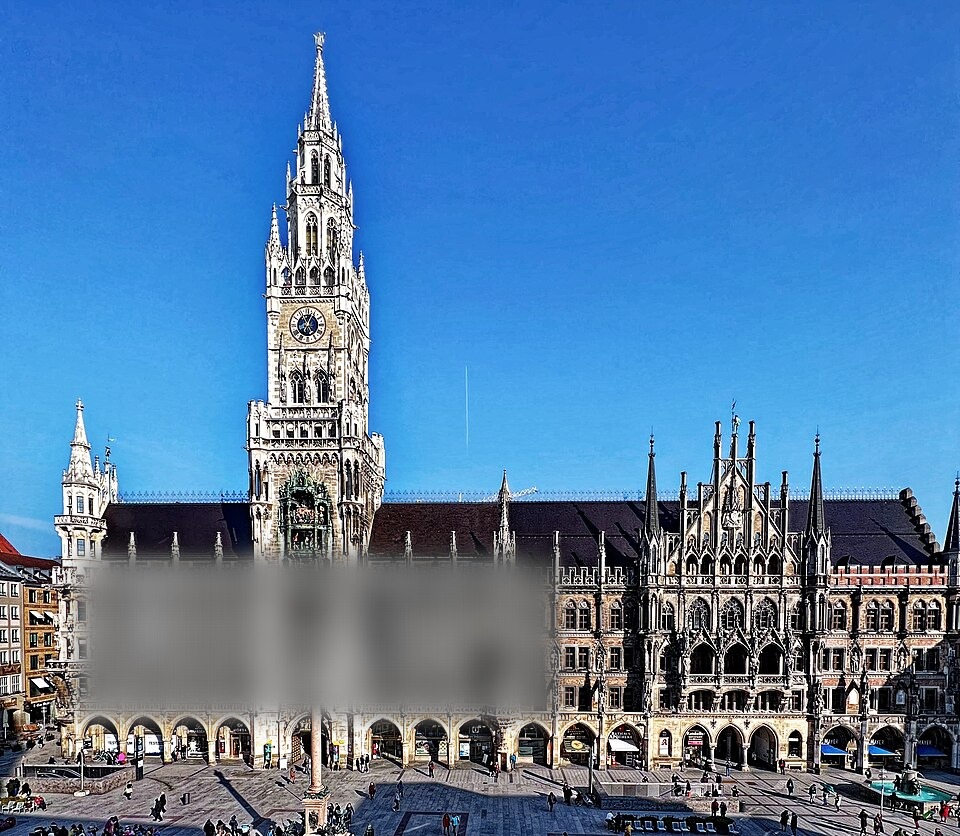
1909 · Georg von Hauberrisser
A long Gothic Revival facade of pointed arches, pinnacles and stepped gables closes off one whole side of a central square, its many small towers breaking the skyline where a plainer, older town hall once stood.
This Gothic Revival building forms the entire northern side of a central square and serves as the working seat of city government, housing the council chamber, the offices of the mayors and part of the municipal administration. It replaced an older town hall nearby, though construction continued in stages long after officials had already moved in. The finished building is protected as an architectural heritage monument in Bavaria.
- City administrators moved out of the old town hall and into this one in 1874, more than three decades before construction was finished in 1909.
Photo: Burkhard Mücke (CC BY-SA 4.0)
Munich Frauenkirche
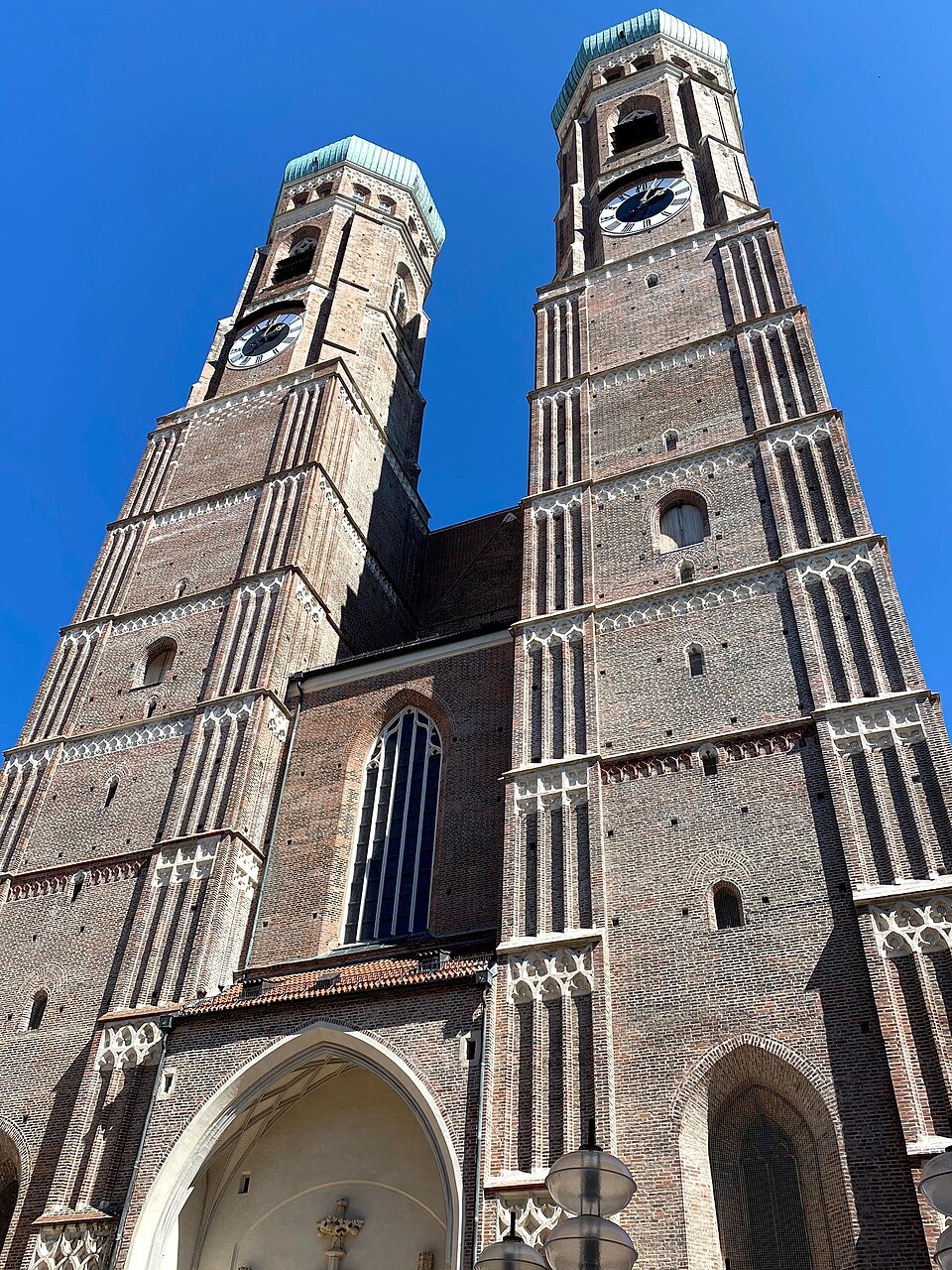
1488 · Jörg von Halsbach
Two towers rise above a skyline that a local law keeps deliberately low around them; one tower has been open to climbers and an elevator since a 2022 renovation, with views reaching toward nearby mountains.
This is the cathedral of an archdiocese and the seat of its archbishop, though local usage keeps its older name rather than the formal title used on its own website. Reckoned the largest hall church anywhere, its twin towers are shielded from being overshadowed: a narrow local vote set a 99-meter limit on nearby construction, later extended across the whole city. One tower, reopened to climbers and an elevator after a 2022 renovation, gives views reaching toward nearby mountains.
- Although its own website calls it a cathedral by a formal Latin-derived title, residents almost always use the older name instead.
- The height restriction protecting its towers began as a plebiscite decided by a narrow margin, then was extended across the entire city in 2004.
Photo: -wuppertaler (CC BY-SA 4.0)
Nymphenburg Palace
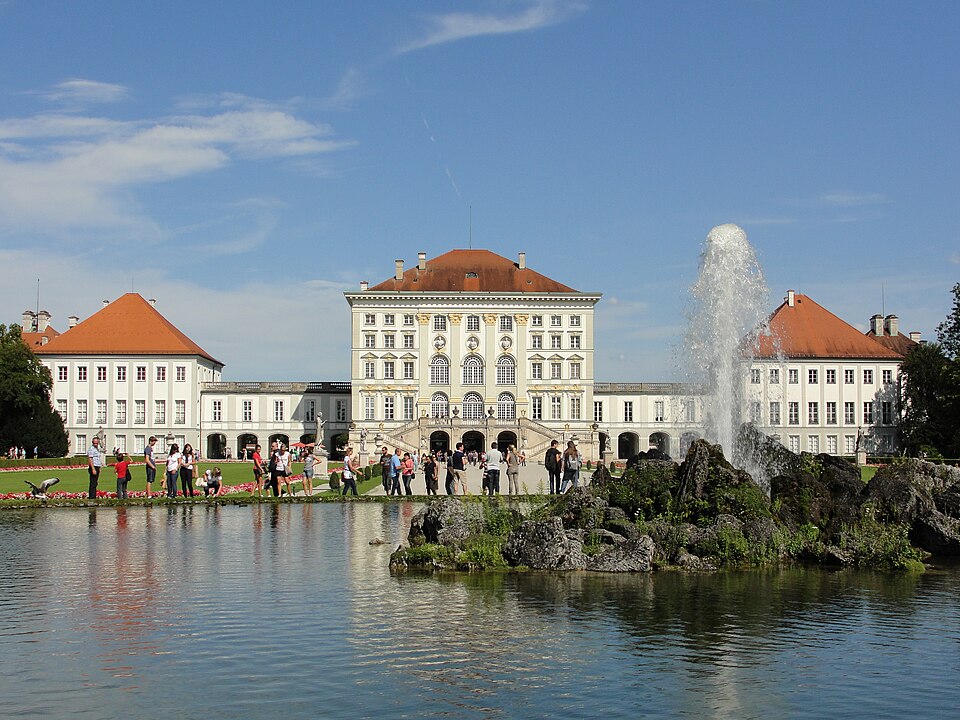
1675 · Agostino Barelli
A very long, flat Baroque front, measured at 632 meters from wing to wing along a north-south axis, faces a formal park it was designed to align with.
Commissioned as the main summer residence for a ruling dynasty, this Baroque palace stands in a western district, its design begun by Agostino Barelli and continued under Lorenzo Perti. Combined with its adjoining formal park, it ranks among Europe's foremost royal palaces. Today it functions partly as a museum, and the palace and grounds together are protected as a heritage ensemble in Bavaria.
- Its garden front, at 632 meters, is wider than the front of the palace of Versailles.
Photo: JohannesSch. (Serafim 89) (CC BY-SA 3.0)
Theatine Church
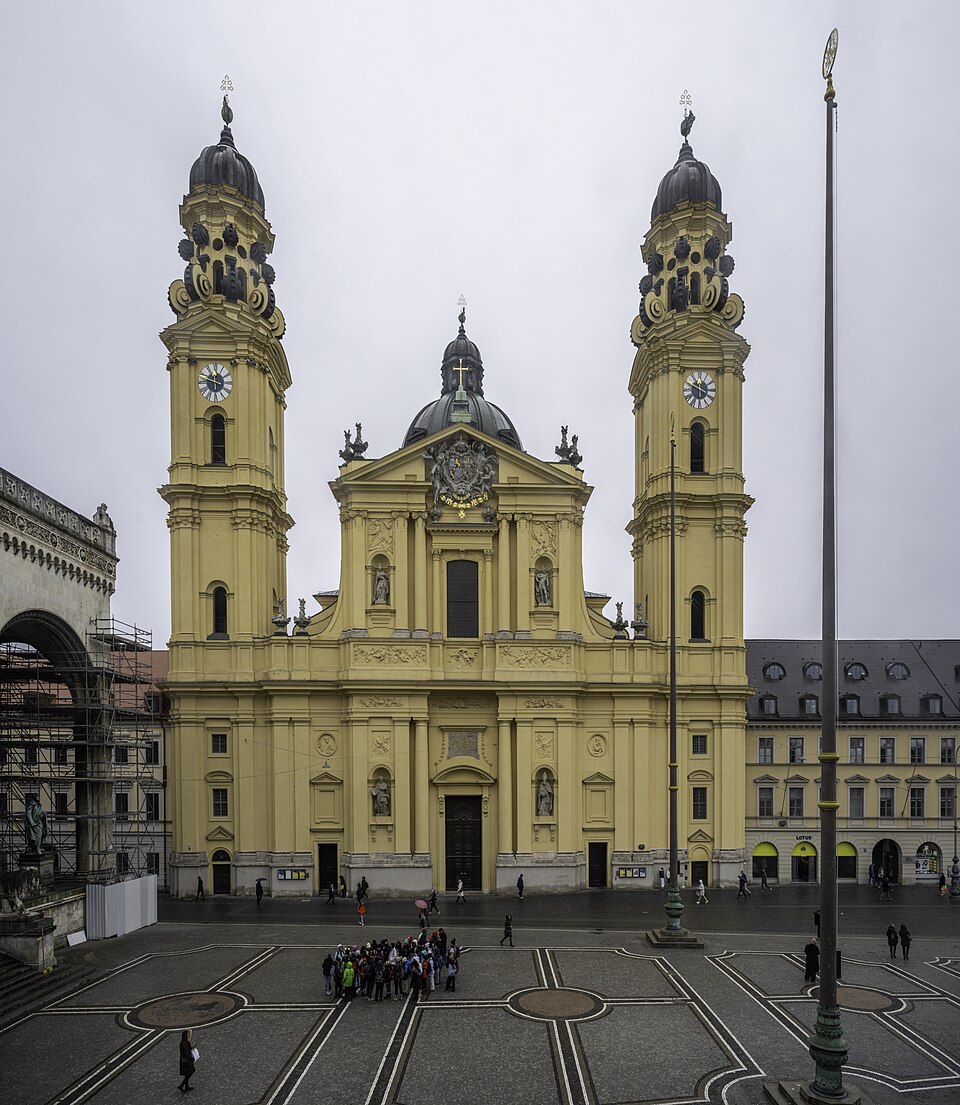
1663–1690 · Agostino Barelli
A pair of towers over 64 meters tall flank a dome rising to 71 meters, the whole front finished in a warm yellow beneath an ornate facade added a century after construction began, a Mediterranean look unusual for the region.
Commissioned by an Elector and his wife as thanks for the birth of a long-awaited heir in 1662, this Roman Catholic church took its Italian High Baroque design, modeled on a Roman basilica, from Agostino Barelli. His successor, Enrico Zuccalli, added twin towers that were not part of the original plan and completed the dome in 1690. A Rococo facade by François de Cuvilliés followed in 1768. Now run by the Dominican Order, it is also called the Dominican Priory of St. Cajetan.
- Its Rococo facade, added in 1768, arrived roughly a century after construction began.
- The yellow, Mediterranean-toned exterior became such a recognizable symbol of the city that it shaped Baroque church design elsewhere in the region.
Photo: Wilfredor (CC0)
Siegestor
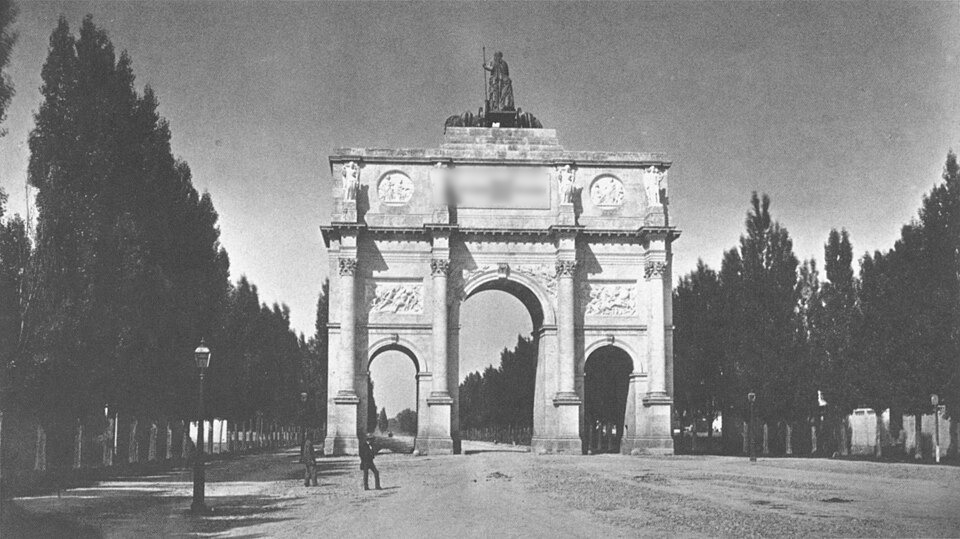
1852 · Friedrich von Gärtner
Three arches support a bronze quadriga crowned by a personification of a region, standing at a compact 21 meters high where a grand avenue changes its name, on the boundary between two city districts.
This three-arched triumphal arch was designed by Friedrich von Gärtner, who died five years before its completion. Crowned with a bronze quadriga carrying a personification of Bavaria, it was originally dedicated to a former kingdom's army. Measuring 21 meters high, 24 meters wide and 12 meters deep, it spans a point where one avenue takes over from another, on the boundary between two city districts. Wartime damage led to a postwar restoration that reframed it as a monument to peace rather than military glory.
- Its designer, Friedrich von Gärtner, died five years before the arch was finished.
- What began as a monument to a kingdom's army was rededicated, after wartime damage, as a call for peace.
Photo: Franz Hanfstaengl (Public domain)
Olympiastadion
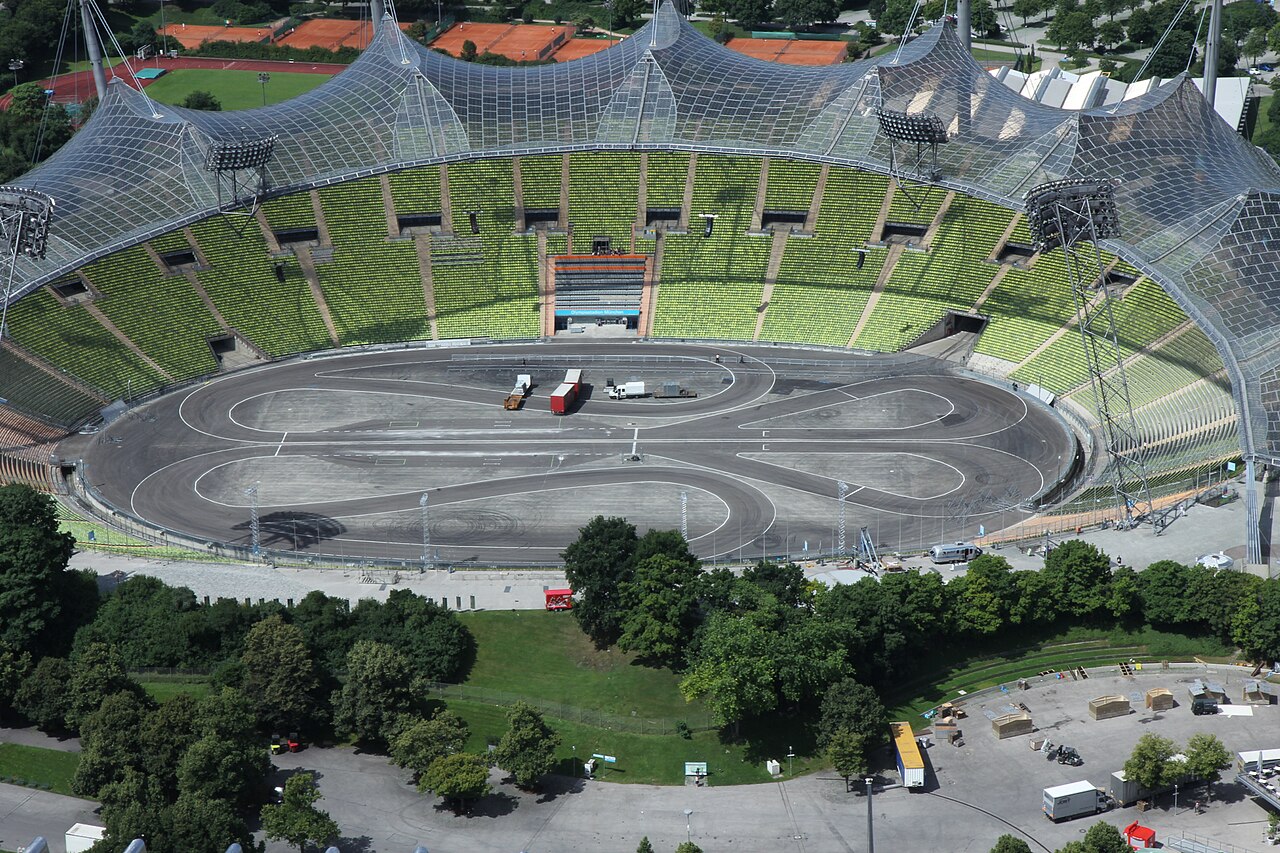
1972 · Günther Behnisch
Sweeping, tent-like canopies of translucent acrylic panels, suspended from steel cables and tall masts, spread over the stands and the open plaza around them, their irregular peaks said to echo the outline of nearby mountains.
Raised as the main venue for the 1972 Summer Olympics, this stadium sits at the heart of a larger park built for the games. Günther Behnisch designed it with engineer Frei Otto, whose lightweight tent construction—steel cables stabilizing sweeping acrylic-glass canopies—was considered revolutionary and was meant to contrast with the enclosed stadiums of the 1936 Games. It later hosted a football World Cup final, a European Championship final, and three European Cup finals. Bayern Munich and 1860 Munich played here until Allianz Arena opened in 2006; it remains Munich's main athletics venue.
- The canopy's design was meant to evoke the outline of the nearby Alps and serve as a democratic counterpoint to the enclosed stadiums of the 1936 Berlin Olympics, held under the Nazi regime.
- Concert seating in the stadium can reach 77,337, well above the 63,118-seat capacity used for sport.
Photo: Sven Teschke, Büdingen (CC BY-SA 3.0 de)
Alte Pinakothek
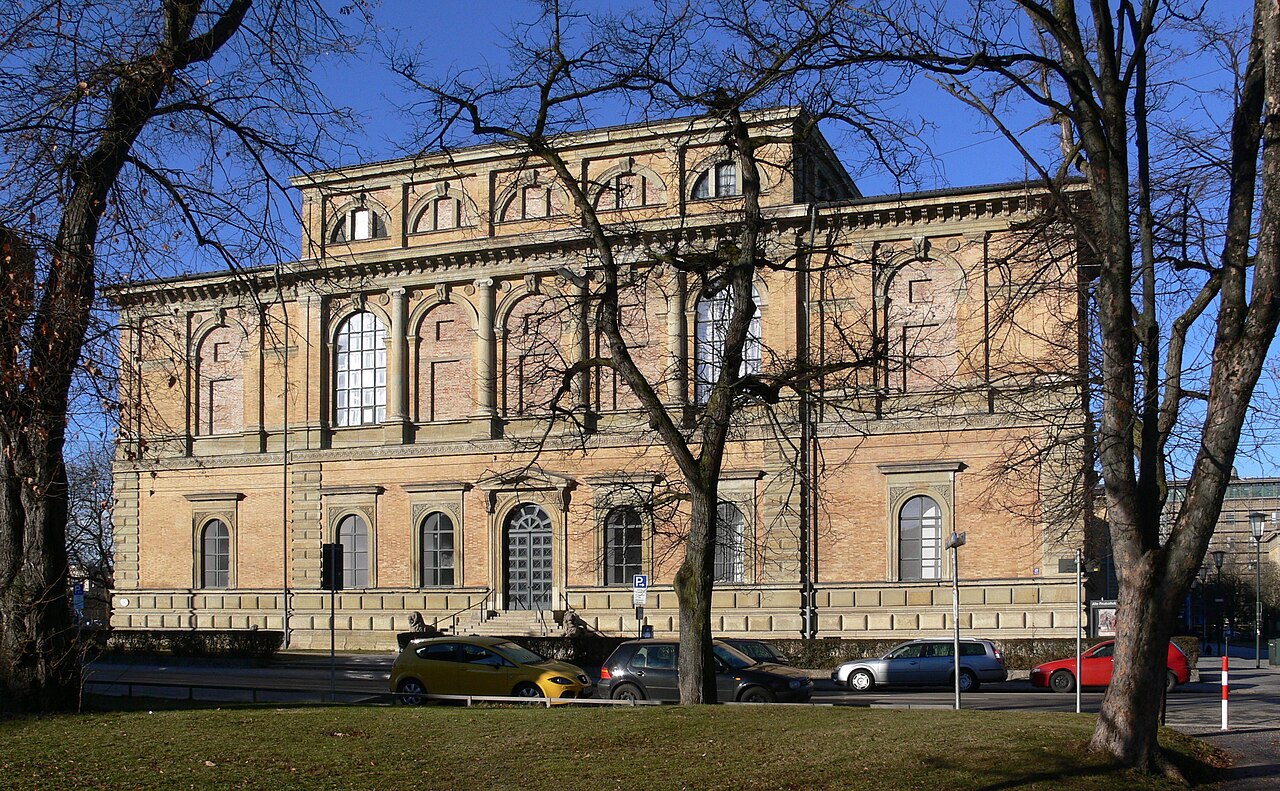
1836–1957 · Leo von Klenze
A freestanding Neo-Renaissance block 150 meters long, faced in yellow, polished brick, its central section rebuilt after 1944 in rougher rubble brick left visibly different in color and texture from the original masonry rather than disguised to match it.
This art museum in the Kunstareal district houses Old Master paintings from the fourteenth to eighteenth century and forms one third of the Bavarian State Painting Collections, alongside the Neue Pinakothek and the Pinakothek der Moderne. King Ludwig I commissioned Leo von Klenze's Neo-Renaissance design, completed in 1836 and widely copied by later European galleries. Allied bombing gutted the building in 1944, tearing a 45-meter hole through its center. Architect Hans Döllgast rebuilt it between 1952 and 1957, deliberately leaving the repaired brickwork visible rather than restoring the original ornate interior.
- Postwar looters stripped the bombed-out ruin of anything valuable before it was used as a dumping ground for rubble.
- A 2008 renovation covered the upper-floor walls in green and red silk woven in Lyon, reviving a color scheme used since the building's construction in the 1830s.
- The museum's skylight-lit galleries were considered so advanced on opening that later galleries, including the Hermitage in Saint Petersburg, were modeled on it.
Photo: Photo: Andreas Praefcke (CC BY 3.0)
Residenz
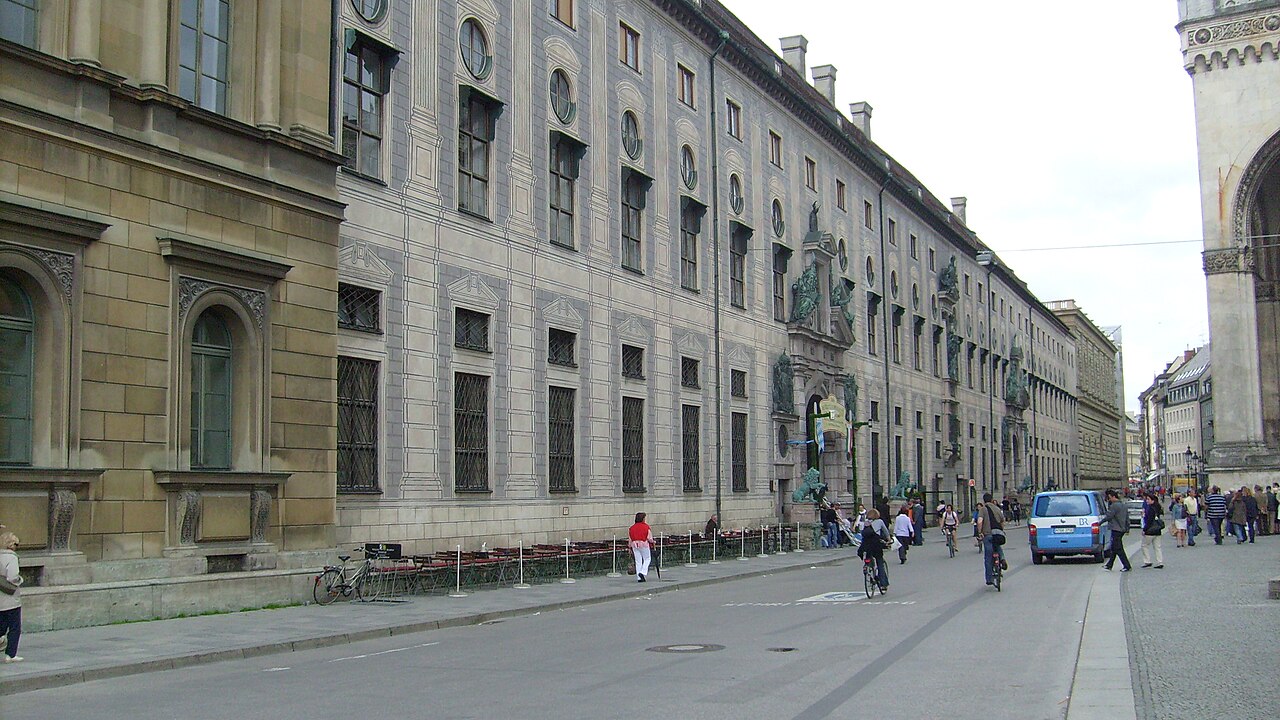
1385–1835
A dense block of linked wings and ten internal courtyards covers what was once an entire city quarter, its pale south-facing wing, modeled on a Florentine palace and standing 30 meters high, giving the complex its most photographed facade.
This former royal palace of the ruling Bavarian dynasty grew, over four centuries, into the largest city palace in Germany, holding ten courtyards and around 130 rooms. Its earliest section, the fortified Neuveste, went up in 1385 after Munich's township was forced to fund it as punishment for a failed uprising. Later work added Friedrich Sustris's Renaissance courtyards in the 1580s, a Rococo gallery by François Cuvilliés the Elder in the 1730s, and Leo von Klenze's Neoclassical Königsbau wing, modeled on Florence's Palazzo Pitti and finished in 1835. A wing was rebuilt after wartime damage in the Second World War.
- The palace's oldest surviving parts, Gothic foundation walls and vaulted cellars, belong to a fortress the city was forced to finance as punishment for a failed revolt against its rulers.
- Its Königsbau wing was modeled directly on the Palazzo Pitti in Florence.
- The Cuvilliés Theatre only came to stand inside the Festsaalbau wing after the palace's post-war reconstruction relocated it there.
Photo: Sandor Bordas (CC BY-SA 3.0)
Englischer Garten
A public park begun in 1789 under Sir Benjamin Thompson, later Count Rumford, for Prince Charles Theodore, Elector of Bavaria. Covering 3.7 square kilometres, it ranks among the world's largest urban parks and takes its style from the informal English landscape garden.
Deutsches Museum
The world's largest science and technology museum, founded on 28 June 1903 at a meeting of the Association of German Engineers on the initiative of Oskar von Miller. It displays about 125,000 objects across 50 fields and receives roughly 1.5 million visitors a year.
National Theatre
A historic opera house on Max-Joseph-Platz, home to the Bavarian State Opera, the Bavarian State Orchestra and the Bavarian State Ballet. With 2,101 seats, it is Germany's largest opera house.
Glyptothek
A museum built from 1816 to 1830 to house King Ludwig I's collection of Greek and Roman sculpture. Designed by Leo von Klenze in the neoclassical style, it is now part of the Kunstareal museum quarter.
Feldherrnhalle
A monumental loggia on the Odeonsplatz, modelled on the Loggia dei Lanzi in Florence and commissioned in 1841 by King Ludwig I to honour the Bavarian Army. In 1923 it was the site of the brief battle that ended Hitler's Beer Hall Putsch.
Odeonsplatz
A large square in central Munich, developed in the early 19th century by Leo von Klenze and named for the former Odeon concert hall. It was the scene of the fatal gun battle that ended the 1923 Beer Hall Putsch march on the nearby Feldherrnhalle.
Bavaria statue
A colossal bronze statue personifying the Bavarian homeland, cast at Munich's Stiglmair foundry between 1844 and 1850. Standing 18.52 metres tall and weighing about 87 tons, it was the first colossal statue since antiquity made entirely of cast bronze.
Chinese Tower
A 25-metre wooden pagoda in the Englischer Garten, built in 1789–1790 and opened as an observation deck in 1792. Burned down during World War II bombing and rebuilt in 1952, it has hosted the Kocherlball festival every third Sunday of July since 1989.
Olympiapark
Olympic park built for the 1972 Summer Olympics in the Oberwiesenfeld neighbourhood, considered an architectural marvel at the time. It continues to host cultural, social and religious events and includes a contemporary carillon, run by the city-owned Olympiapark München GmbH.
Neue Pinakothek
An art museum focused on European art of the 18th and 19th centuries, ranked among the world's most important collections of nineteenth-century art. It forms part of Munich's Kunstareal museum quarter alongside the Alte Pinakothek and the Pinakothek der Moderne.
Haus der Kunst
A museum of modern and contemporary art at the southern edge of the Englischer Garten, built between 1933 and 1937 in a monumental neoclassical design by Paul Troost. It was commissioned by Adolf Hitler and originally opened as the Haus der deutschen Kunst.
Bavarian National Museum
One of the most important museums of decorative arts in Europe and one of the largest art museums in Germany. Its collection has always been divided into two main groups, an art-historical collection and a folklore collection.
Lenbachhaus
A building in Munich's Kunstareal housing the Städtische Galerie, the city's municipal art gallery museum.
Pinakothek der Moderne
A modern art museum situated in central Munich's Kunstareal museum quarter.
St. Michael's Church
A Jesuit church, and the largest Renaissance church north of the Alps. Its design had a major influence on early Baroque architecture in southern Germany.
Staatliche Antikensammlungen
A museum in the Kunstareal holding Bavaria's collections of antiquities from Greece, Etruria and Rome. Its sculpture holdings are displayed across the square in the Glyptothek, while Bavarian-made antiquities and Egyptian art each have separate museums.
Palais Leuchtenberg
The largest palace in Munich, built in the early 19th century for Eugène de Beauharnais, first Duke of Leuchtenberg. It stands on the Odeonsplatz, was once known as the Luitpold Palais, and now houses the Bavarian State Ministry of Finance.
Bavarian State Library
Bavaria's central state library, the largest universal and research library in Germany and one of Europe's most important, holding around 39.4 million items. It holds one of the world's most important manuscript collections, the largest incunabula collection anywhere, and ranks as Europe's second-largest journals library.
Fischbrunnen
A fountain in the centre of Munich whose history traces back to the Middle Ages. Josef Henselmann rebuilt it in its present form in 1954, incorporating parts of Konrad Knoll's neo-Gothic fountain, which had been destroyed in World War II.
Museum Five Continents
A museum of non-European art and cultural objects in Munich. It was known as the Bavarian State Museum of Ethnology until it was renamed on 9 September 2014.
Museum Brandhorst
A modern art museum that opened on 21 May 2009, displaying around 200 works from the collection of Udo and Anette Brandhorst, heirs to the Henkel trust. By 2009 the Brandhorst Collection totalled more than 700 works.
Staatliches Museum Ägyptischer Kunst
An archaeological museum holding Bavaria's state collection of ancient Egyptian art from both the predynastic and dynastic periods, with a small associated section on Assyrian and Babylonian culture. For decades it was housed in the Munich Residenz before moving to the Kunstareal in June 2013.
History
Munich's first documented mention dates to 1158, and it held to Catholicism through the Reformation while other German territories turned Protestant. It became the capital of the Kingdom of Bavaria in 1806, a status that drove a construction boom in arts, architecture, culture and science through the nineteenth century, the period that produced its Neoclassical triumphal arch and its Gothic Revival town hall on the main square. Wittelsbach rule, which had shaped the city since the Middle Ages through Baroque commissions such as its western summer palace and its yellow parish church, ended in 1918 with a revolution that briefly installed a Bavarian Soviet Republic. Further political upheaval followed through the 1920s, before later rebuilding reshaped the city into the form its landmarks now sit in.