Landmarks in Edinburgh
A fortress on a volcanic crag anchors a skyline of Gothic spires and a royal palace.
Edinburgh's skyline is arranged around Castle Rock, a volcanic outcrop that has carried a fortress since at least the eleventh century and still dominates the historic core. Around its base, the oldest public buildings cluster along the ridge running down toward Holyrood: a Gothic cathedral rebuilt across the fourteenth to sixteenth centuries, and, at the foot of the slope, the royal palace that has hosted the monarch in Scotland since the sixteenth century. Nineteenth-century Edinburgh added its own layer, most visibly a Gothic memorial to a novelist standing in a public garden below the castle. Further out, where the Firth of Forth bounds the city to the north, a cantilever railway bridge of 1890 shows the same era's confidence in engineering rather than stone.
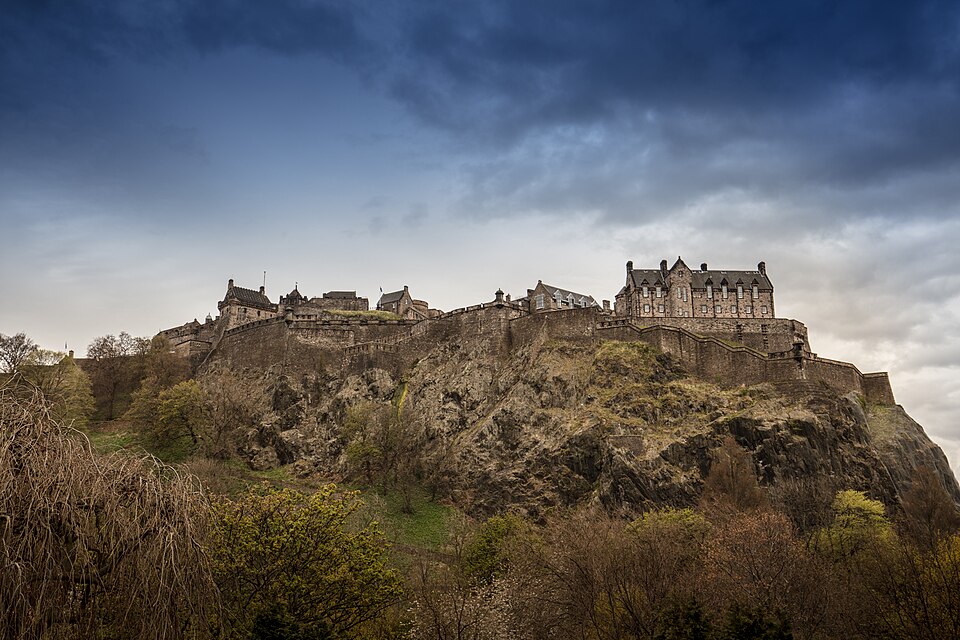
Edinburgh Castle
1103
It occupies the sheer sides of a volcanic crag, its grey battlements and towers stepping up the rock in tiers above the surrounding streets, forming the fortified skyline that closes one end of the city's historic ridge.
A royal castle has stood on Castle Rock since the reign of Malcolm III in the eleventh century, serving as a residence until 1633 before its role shifted to a military garrison from the seventeenth century onward. Over the centuries it has functioned as an arsenal, a treasury, a national archive, a mint, a prison and a fortress, and it holds the Honours of Scotland, the country's regalia. Recognised as a heritage asset from the early nineteenth century, it has undergone restoration since the mid-nineteenth century and today operates chiefly as a museum.
- A 2014 study counted 26 sieges in its history, giving it a claim to being the most besieged place in Great Britain.
- It has served at different times as a mint, a prison, a national archive and a treasury.
Photo: Michael D Beckwith (CC0)
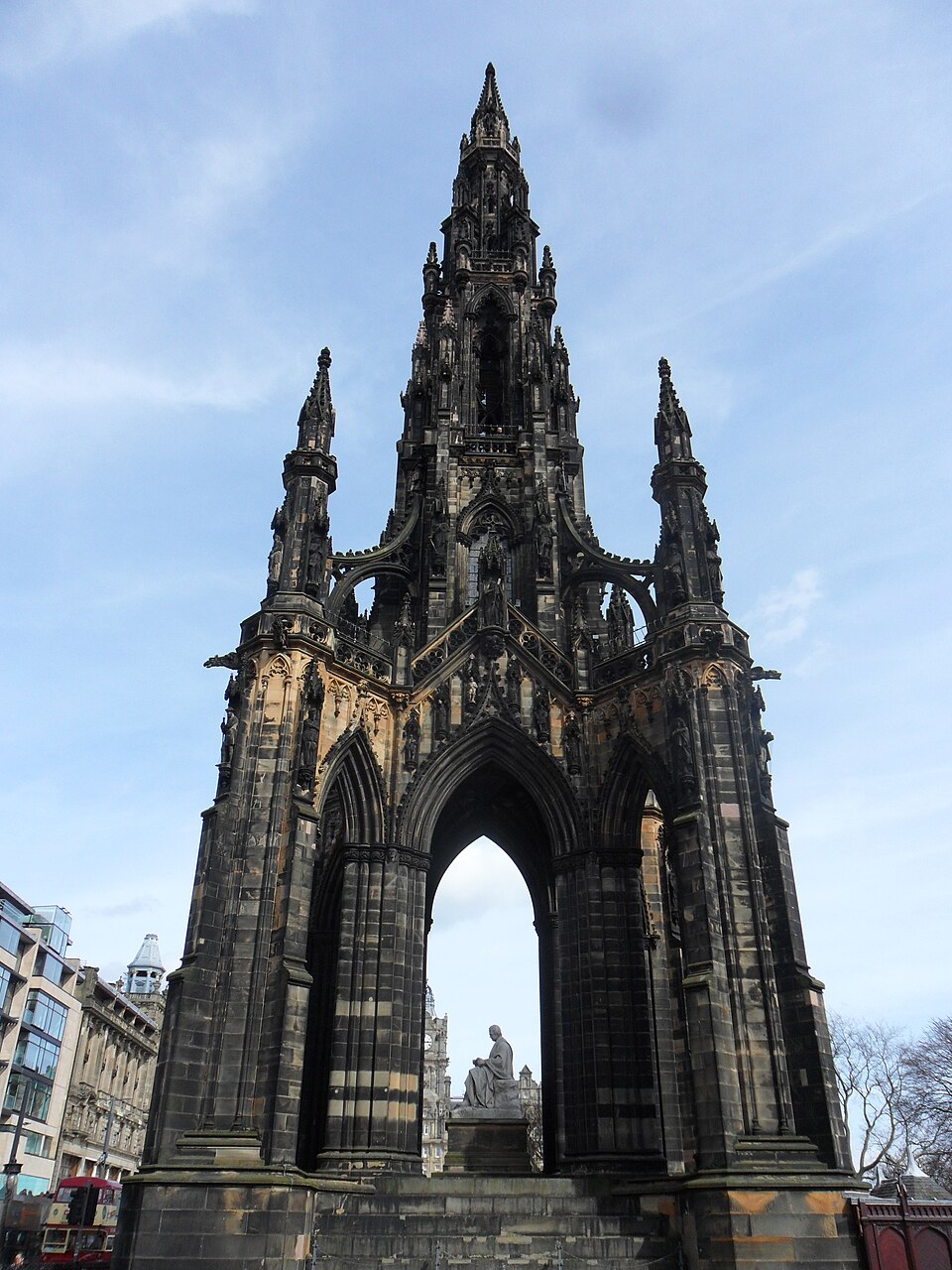
Scott Monument
1844
A dark, multi-tiered stone spire rises alone in a sunken public garden between the main shopping street above and a railway station below, its pointed arches and pinnacles built up in diminishing stages.
This Victorian Gothic memorial honours the novelist and poet Walter Scott. It stands in Princes Street Gardens, facing the former Jenners department store across Princes Street and close to the railway station that takes its name from Scott's Waverley novels. Completed in 1844, it ranks as the second-largest monument built for a writer anywhere in the world, surpassed only by the José Martí monument in Havana.
- It is exceeded in size only by the José Martí monument in Havana among monuments to writers.
- The railway station beside it takes its name from Scott's Waverley novels.
Photo: Enrohm1963 (CC BY-SA 4.0)
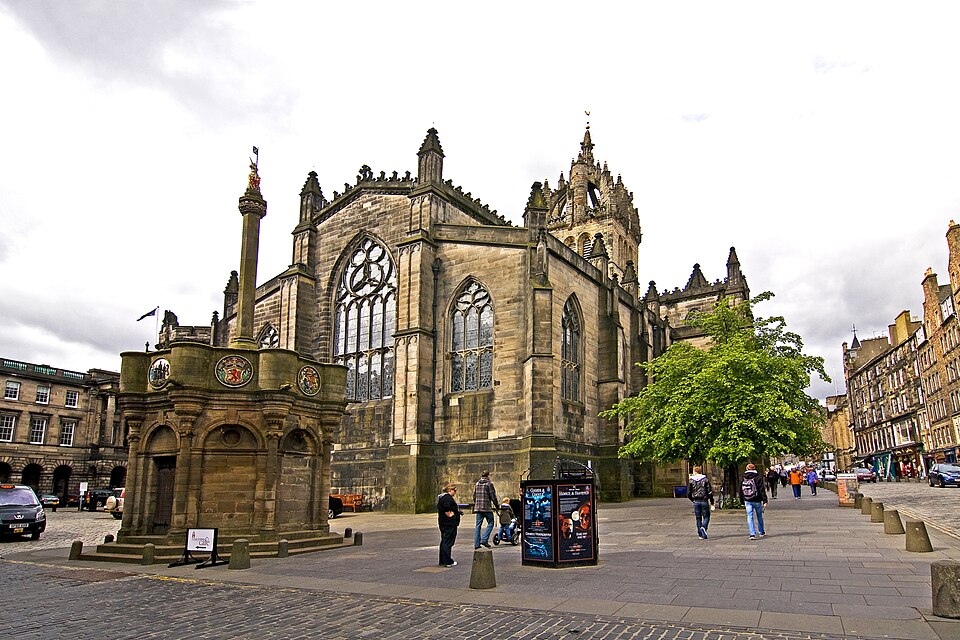
St Giles' Cathedral
14th–16th century
A large Gothic church begun in the fourteenth century stands along the city's main historic street, with a distinct small chapel added onto one corner in the early twentieth century as the later Thistle Chapel.
Probably founded in the twelfth century and dedicated to Saint Giles, the present Gothic building was begun in the fourteenth century and extended until the early sixteenth. It was raised to collegiate status by Pope Paul II in 1467 and turned Protestant in 1559 under John Knox. After the Reformation it was partitioned to house several congregations and, at times, a prison and the meeting place of the Parliament of Scotland; Charles I made it a cathedral in 1633. Alterations continued into the twentieth century, including the addition of the Thistle Chapel.
- In 1637, a riot sparked by a new prayer book imposed by Charles I helped set off the Wars of the Three Kingdoms.
- After the Reformation the building was partitioned to hold several separate congregations, plus, at times, a prison and the meeting place of the Parliament of Scotland, under one roof.
Photo: Alan Findlay (CC BY-SA 2.0)
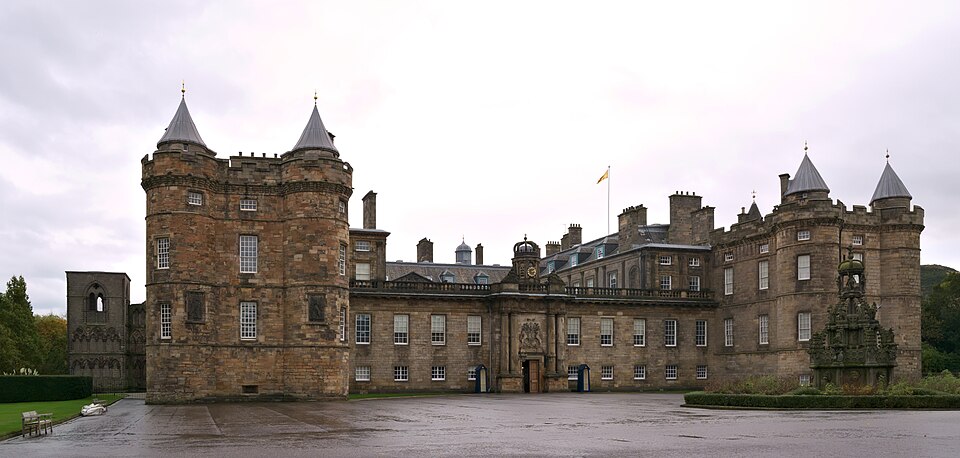
Palace of Holyroodhouse
1679
The palace sits at the foot of the Royal Mile, at the opposite end from Edinburgh Castle, adjoining Holyrood Abbey with its grounds merging into Holyrood Park; a separate gallery building at its western entrance, opened in 2002, displays works from the Royal Collection.
The official residence of the monarch of the United Kingdom in Scotland stands at the foot of the Royal Mile, opposite Edinburgh Castle, adjoining Holyrood Abbey and set within Holyrood Park. It has served as the principal royal residence in Scotland since the sixteenth century and retains the historic apartments of Mary, Queen of Scots alongside State Apartments used for official entertaining. The King's Gallery, converted from existing buildings at the western entrance and opened in 2002, exhibits works from the Royal Collection. The monarch resides there for a week each summer.
- The King's Gallery, opened in 2002, was converted from existing buildings rather than built new.
- For one week each summer the monarch is formally in residence, and the State Apartments close to visitors.
Photo: Daniel Kraft (CC BY-SA 3.0)
Forth Bridge
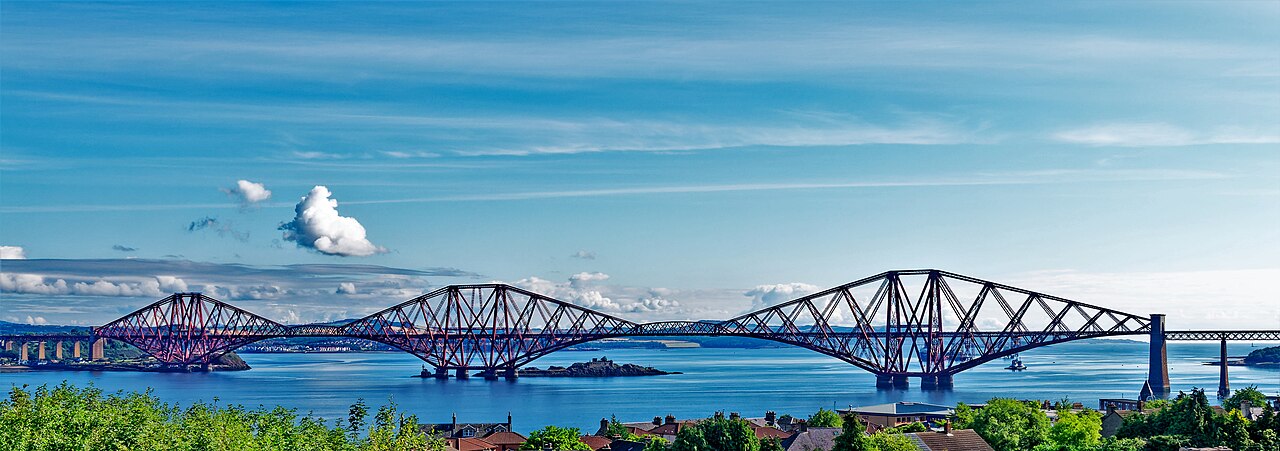
1890 · John Fowler and Benjamin Baker
Steel lattice cantilever towers rise from piers set in the water, linked by trusses that carry a double railway line for 2,467 metres between two small ferry villages on opposite shores.
This cantilever railway bridge crosses the Firth of Forth some nine miles west of central Edinburgh, carrying the Edinburgh–Aberdeen line between the villages of South Queensferry and North Queensferry. Designed by engineers John Fowler and Benjamin Baker, it was built from 1882 and opened on 4 March 1890 by the Duke of Rothesay, later Edward VII. At 2,467 metres long, it held the record for the world's longest single cantilever span until 1919 and remains the second-longest. It is a UNESCO World Heritage Site owned by Network Rail.
- Its main span held the world record for the longest single cantilever bridge until Canada's Quebec Bridge overtook it in 1919.
- It was opened in 1890 by the Duke of Rothesay, who later became King Edward VII.
- A 2016 poll voted it Scotland's greatest man-made wonder.
Photo: George Gastin (CC BY-SA 3.0)
Calton Hill
A hill beyond the east end of Princes Street, part of the city's UNESCO World Heritage Site. It carries a cluster of monuments, including the National Monument, the Nelson Monument and the City Observatory, and is home to the headquarters of the Scottish Government.
Royal Mile
A series of streets forming the main thoroughfare of the Old Town, running almost exactly one mile between Edinburgh Castle and Holyrood Palace. It is the busiest tourist street in the Old Town and becomes especially crowded each year during the Edinburgh Fringe.
Greyfriars Kirkyard
The graveyard surrounding Greyfriars Kirk, at the southern edge of the Old Town next to George Heriot's School. Burials have taken place there since the late 16th century, and it is protected as a category A listed building.
Scottish National Gallery
The national art gallery of Scotland, designed in neoclassical style by William Henry Playfair and opened to the public in 1859. It stands on The Mound near Princes Street and is often confused with the architecturally similar Royal Scottish Academy next door.
National Museum of Scotland
A museum of Scottish history and culture, formed in 2006 by merging the Museum of Scotland with the Royal Scottish Museum. The two connected buildings stand on Chambers Street at its junction with George IV Bridge, and admission is free.
Charlotte Square
A garden square in the New Town, part of the city's UNESCO World Heritage Site, at the west end of George Street. It was designed to mirror St Andrew Square to the east, though its gardens remain private.
Parliament House
The world's first purpose-built parliament building, completed in 1639 by James Murray at a cost of £10,555. It housed the Parliament of Scotland until 1707 and today contains the Supreme Courts of Scotland across seven floors and 700 rooms.
Royal Botanic Garden
Founded in 1670 as a physic garden for medicinal plants, it now spans four sites across Scotland with more than 13,300 living plant species. Its herbarium holds over 3 million preserved specimens, and the Edinburgh site remains its main garden and headquarters.
Grassmarket
A historic marketplace, street and event space in the Old Town, at the southwest foot of Castle Rock. It lies in a valley, considerably below the surrounding area.
Old Royal High School
A 19th-century neoclassical building on Calton Hill, built for the Royal High School and also known as New Parliament House. After the school relocated in 1968 it was refurbished for a proposed devolved Scottish Assembly, which the 1979 referendum failed to approve.
Scottish National Portrait Gallery
An art museum on Queen Street holding Scotland's national collection of portraits, housed since 1889 in a red sandstone Gothic Revival building. Designed by Robert Rowand Anderson and donated by newspaper owner John Ritchie Findlay, it reopened as 'Portrait' on 1 December 2011.
St Mary's Cathedral (Episcopal)
A cathedral of the Scottish Episcopal Church in the West End, its foundation stone laid in 1874 and consecrated in 1879. Designed in Victorian Gothic Revival style by Sir George Gilbert Scott, it is the seat of the Bishop of Edinburgh.
Royal Scottish Academy
Scotland's national academy of art, founded in 1826 by eleven artists in Edinburgh. Originally the Scottish Academy, it took its royal title in 1838 and remains an independently funded body promoting contemporary Scottish art through exhibitions.
Old College
A late-18th to early-19th-century University of Edinburgh building on South Bridge, originally designed by Robert Adam on the site of the former Kirk o' Field. After delays it was completed to a modified design by William Henry Playfair, with the dome added later.
Scottish National Gallery of Modern Art
A modern and contemporary art museum in two buildings, Modern One and Modern Two, facing each other on Belford Road west of the city centre. Its collection holds more than 6,000 works spanning paintings, sculpture, installation and video, dating from about 1900 to the present.
Usher Hall
A concert hall in the West End, built in 1914 with capacity for about 2,200 people. It hosted the Eurovision Song Contest in March 1972, the first time the event came to Scotland, and staged the boxing at the 1986 Commonwealth Games.
The Hub
A Gothic Revival building at the top of the Royal Mile, its 71.7-metre spire the tallest point in central Edinburgh. Built between 1842 and 1845 by J Gillespie Graham and Augustus Pugin, it now houses the Edinburgh International Festival.
Canongate Kirk
A Church of Scotland congregation serving the Parish of Canongate, which includes the Palace of Holyroodhouse and the Scottish Parliament. It is also the parish church of Edinburgh Castle, and hosted the wedding of Zara Phillips and Mike Tindall on 30 July 2011.
Thistle Chapel
The chapel of the Order of the Thistle, within St Giles' Cathedral, built after King Edward VII ordered its construction in 1906 following a £24,000 donation from the sons of the 11th Earl of Leven. The Trustees appointed Robert Lorimer as its architect.
Dean Cemetery
A historically important Victorian cemetery north of Dean Village, west of the city centre, bounded by Queensferry Road and the Water of Leith. A detached 20th-century extension lies further north, near Ravelston Terrace.
Old Calton Burial Ground
A cemetery on Calton Hill opened in 1718, the resting place of philosopher David Hume and scientist John Playfair. It holds the Political Martyrs' Monument and Scotland's American Civil War Memorial, and was split into two sections by the construction of Waterloo Place in 1819.
Mercat Cross
A market cross standing in Parliament Square next to St Giles' Cathedral, facing the High Street in the Old Town.
Surgeons' Hall
The headquarters of the Royal College of Surgeons of Edinburgh, designed by William Henry Playfair and completed in 1832. It houses the Surgeons' Hall Museum, a collection of national significance that reopened in September 2015 after an eighteen-month redevelopment.
Dundas House
A Neoclassical building at 36 St Andrew Square, completed in 1774 as a private town house for Sir Lawrence Dundas. Much altered and extended since, it is now the registered office of the Royal Bank of Scotland and its parent, NatWest Group.
Dean Bridge
A bridge spanning the Water of Leith on four arches, 447 feet long and rising 106 feet above the riverbed. Completed in 1831, it was one of the last major works of engineer Thomas Telford, who was seventy-three at the time.
History
Edinburgh has been recognised as Scotland's capital since at least the fifteenth century, but its built history starts earlier: a royal castle stood on Castle Rock from the reign of Malcolm III in the eleventh century, though its residential role declined after the fifteenth century and it became a military garrison. St Giles', probably founded in the twelfth century, was rebuilt as a Gothic church across the fourteenth and fifteenth centuries, became collegiate in 1467, turned Protestant in 1559 under John Knox, and was made a cathedral in 1633, tied up in the unrest that followed Charles I's attempt to impose a new prayer book. Holyroodhouse became the principal royal residence from the sixteenth century onward. Later additions read differently: a monument to Walter Scott went up in 1844, and the Forth Bridge, a feat of Victorian steel engineering, opened in 1890.